
Logo

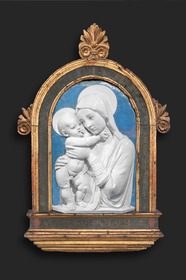
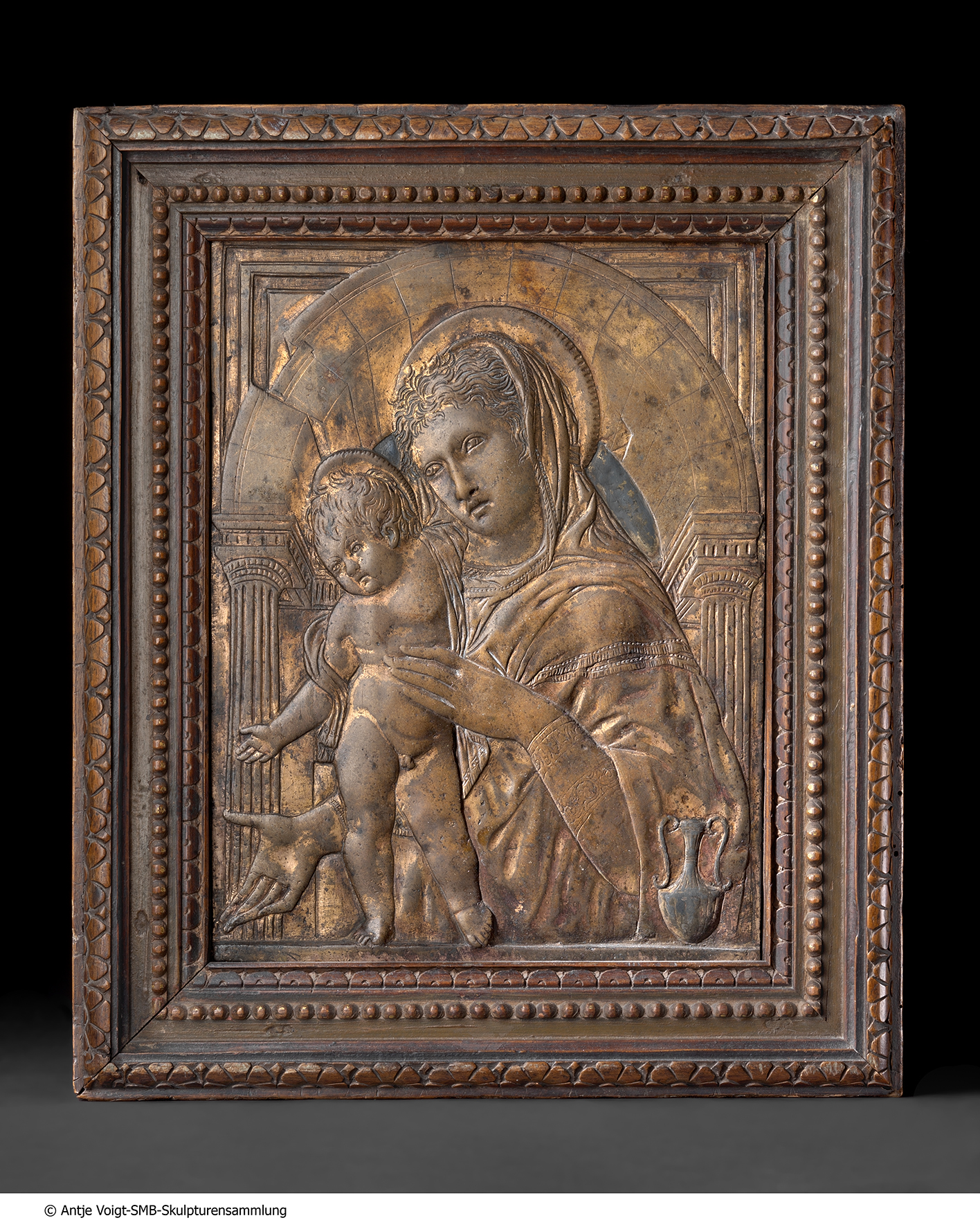
Maria mit Kind in einer Nische / Virgin and Child in a Niche

Ident. Nr.: 3044

ObjID: obj:867946
Details (Expert)

Beteiligte
nach: Donatello (um 1386-1466),
Bildhauer*in
Datierung
Datierung: 15. Jahrhundert
Material / Technik
Bronze, versilbert
Abmessungen
Höhe x Breite x Tiefe: 20,5 x 15,5 x 0,9 cm (Relief)
Höhe x Breite x Tiefe: 27,8 x 23,6 x 4,1 cm (Rahmen)
Gewicht: 2,54 kg

Objektbeschreibung

After Donatello
Donato di Niccolò di Betto Bardi
Florence ca. 1386-1466

Virgin and Child in a Niche

Bronze, with traces of silver
20,3 x 15,3 cm

Berlin, Staatliche Museen, Skulpturensammlung, Inv. SKS 3044.
Bode-Museum, on view.


Provenance
Berlin, Hainauer Collection (before 1906); Berlin, Skulpturensammlung/Kaiser-Friedrich-Museum (1906-1939); Berlin, storage (1939-1945); Merkers, storage (1945); Wiesbaden, Central Collecting Point (1945-1956); West Berlin, Skulpturensammlung/Museum Dahlem (1956-1990); Berlin, Skulpturensammlung/Museum Dahlem (1990-1997); Berlin, storage (1997-2006); Berlin, Skulpturensammlung/Bode-Museum (since 2006).

Acquisition
Gift of Henry Duveen, Duveen Brothers, London, 1906; as by Donatello. Acquisition file n°F. 1395/06 (untraced).

Other versions
• Berlin, Staatliche Museen, Skulpturensammlung, Inv. SKS 76. Painted stucco.
• Budapest, Szépmüvészeti Múzeum, Inv. No. 2049: Stucco, 69 x 32 cm.
• Florence, via del Corso.
• Florence, via Ghibellina.
• London, The Wallace Collection. Inv. S 297. Bronze, 20.3 x 15.3 cm.
• London, Victoria and Albert Museum, Inv. 7385-1861. Stucco, 47,5 x 32,5 cm; 20 x 15,5 cm without frame.
• Orbignano (Pistoia), Santa Maria. Marble.
• Paris, Musée du Louvre, Inv. 704. Terracotta, 21.8 x 16.9 cm.
• Ravenna. Marble.
• Sinalunga, SM delle Nevi.
• Vatican State, Museo Sacro. Marble (KIF 171507).
• Washington DC, National Gallery of Art, Kress Collection, Inv. 1957.14.131. Bronz ( Formerly Paris, Gustave Dreyfus collecti.)
• Formerly Amsterdam, private collection.
• Formerly Florence, Grassi collection. Bronze (Photo Kunsthistorisches Institut Florenz n°59966).
• Formerly London, Christie’s, sale 7th July 1987, lot 150.
• Formerly New York, sale of the Raoul Tolentino collection, 1926, lot. 719. Stucco.

Curatorial Files in the Bode-Museum
Letter from Ulrich Middeldorf to Peter Metz, 9 January 1961: discusses the rediscovered version in Orbignano.

Comment

This bronze relief of the Virgin and Child is known in several other versions, the closest two to the present one being in the National Gallery of Art, Washington DC and in the Wallace Collection, London. The Virgin holds her standing Child with her left hand, while gesturing invitingly toward the viewer with the other – a gesture echoed by the right hand of Christ, who holds onto the neck of his mother with his other hand, in a realistic depiction of trying to maintain balance. Both figures are seen behind a balustrade on which the Child is standing, and a vase is displayed; they stand out from a niche seen in perspective, which appears to be at some distance behind them.
It is not a coincidence that the name of Donatello has always been mentioned when discussing this typology of the Madonna and Child: the pose of the Madonna with the left arm parallel to the picture plane recalls another plaquette with a Donatellesque attribution (see Inv. SKS 1028), while the open right hand is a motif used in the High Altar of the Santo in Padua. The anatomy of the Child is typical of Donatello, as is the way his left arm is hidden behind his mother’s head, with only the tips of the fingers discernable (see Inv. SKS 1940). The architecture of the niche, seen in perspective and with reference to Antique forms that are now in ruins, is present in many works by the artist, such as the bronze relief of the Feast of Herod made for the Baptistery Font in the Cathedral of Siena. Rather than Donatello himself, whose direct style cannot be recognized in any version of the series, the critics have generally and convincingly seen the relief as by an artist from his school, probably after a model by the master (Bode 1897; Schubring 1907b). In 1961, a Madonna relief in marble was found in Santa Maria, Orbignano and attributed to Donatello by the local press (N. V. 1961); however, this relief is too weak to be by Donatello and is certainly by Urbano da Cortona instead, who authored the reliefs from the Chapel of the Madonna delle Grazie in Siena Cathederal, now in the Museo dell’opera metropolitana, Siena.
The composition was reproduced in a drawing by the school of Pisanello preserved in the Musée Condé, Chantilly (the absence of a vase having made Jolly 1998 think that is was missing from the original composition, which is far from convincing). Christiansen 2004 related the work to Florentine painters such as Paolo Uccello and the Master of Pratovecchio; the echoes of such a composition are also especially important with artists in the region of Padua, such as Giorgio Schiavone (National Gallery, London); Marco Zoppo (British Museum, London, Inv. 1920-2-14-2); Niccolò Baroncelli (the Miracle of St Gilles, Museo Civico, Padua; see Galli 2010); or Andrea Mantegna (see Edskerdjian 1992). It is conceivable that the prototype for this work was made by Donatello between Padua and Florence, i.e. during the 1440s.


Literature
Molinier 1886
Émile Molinier, Les Bronzes de la Renaissance. Les plaquettes. Catalogue raisonné, Paris, Jules Rouam, 1886, I, p. 34 cat. 64: Donatello, mentions the bronze version in the G. Dreyfus collection now in the National Gallery of Art, Washington DC, and the variant in terracotta in the Musée du Louvre.
Bode 1897
Wilhelm Bode, Die Sammlung Oscar Hainauer, Berlin, W. Büxenstein, 1897, pp. 29, 80 cat. 127: school of Donatello.
Schubring 1907a
Paul Schubring, Donatello. Des Meisters Werke in 277 Abbildungen, Stuttgart and Leipzig, Deutsche Verlags-Anstalt, 1907, pp. 170, 201: circle of Donatello.
Schubring 1907b
Paul Schubring, “Gli acquisti del museo ‘Kaiser Friedrich’”, L’Arte, X, 1907, p. 452: not Donatello, but a pupil.
Bange 1922
E. F. Bange, Die Italienischen Bronzen der Renaissance und des Barock, Zweiter Teil: Reliefs und Plaketten, Berlin and Leipzig, Walter de Gruyter, 1922, p. 1 cat. 3: Donatello.
Kauffmann 1935
Hans Kauffmann, Donatello. Eine Einführung in sein Bilden und Denken, Berlin, Grotesche Verlagsbuchandlung, 1935, pp. 156, 223.
Landais 1958
Hubert Landais, Les bronzes italiens de la Renaissance, Paris, Presses universitaires de France, 1958, p. 33: close to Donatello; same artist as the bronze Flagellation in Berlin (Inv. SKS 1027); the Camondo Crucufixion in the Musée du Louvre, Paris; and the St Sebastian in the Musée Jacquemart-André, Paris.
N. V. 1961
N. V., La Nazione, 19 juin 1961, p. 5: original version by Donatello in Santa Maria, Orbignano.
Pope-Hennessy 1964
John Pope-Hennessy, Catalogue of Italian Sculpture in the Victoria and Albert Museum, London, Her Majesty’s Stationary Office, 1964, I, p. 91: style of Donatello.
Pope-Hennessy 1965
John Pope-Hennessy, Renaissance Bronzes from the Samuel H. Kress Collection, London, Phaidon Press, 1965, p. 21: related to cat. 60 in the Kress collection; style of Donatello, made by a member of Donatello’s Paduan workshop; the gesture of the Virgin is a derivation from the St Giustina made for the High Altar at Padua.
Metz 1966
Peter Metz, Bildwerke der christlichen Epochen von der Spätantike bis zum Klassizismus aus den Beständen der Skulpturenabteilung der Staatliche Museen, Stiftung Preußischer Kulturbesitz, Berlin-Dahlem, Munich, Prestel, 1966, p. 89-90, cat. 501: after Donatello.
Markham Schulz 1983
Anne Markham Schulz, Antonio Rizzo. Sculptor and Architect, Princeton, Princeton University Press, 1983, p. 26: probably after an original by Donatello; derivation in a tondo by Antonio Rizzo in the Rijksmuseum, Amsterdam.
Luchs 1985
Allison Luchs in Italian Renaissance Sculpture in the Time of Donatello, exh. cat. (Detroit, The Detroit Institute of Arts, 23 October 1985-5 January 1986 and Fort Worth, Kimbell Museum of Art, 22 February-5 April 1986), Detroit, The Detroit Institute of Arts, 1985, p. 140: formerly in Berlin, “also extremely good”.
Luchs 1986
Allison Luchs in Alan Phipps Darr and Giorgio Bonsanti (eds.), Donatello e i suoi, exh. cat. (Florence, Forte del Belvedere, 15 June-7 September 1986), Detroit and Florence, The Detroit Institute of Arts, La Casa Usher and Arnaldo Mondadori Editore, 1986, p. 167: destroyed.
Avery 1989
Charles Avery, “Donatello’s Madonnas Revisited”, in Donatello Studien, Munich, Brückmann, 1989, pp. 226-227: after Donatello, ca. 1427-1430.
Kokole 1990
Stanko Kokole, “Notes on the Sculptural Sources for Giorgio Schiavone’s Madonna in London”, Venezia Arti, 1990/4, p. 52: after Donatello in Padua; discusses the Washington version only; Virgin and Child by Giorgio Schiavone in the National Gallery, London (Inv. NG 904), is seen as a derivation.
Avery 1991
Charles Avery, Donatello. Catalogo completo delle opere, Florence, Cantini, 1991, p. 50 cat. 31: Donatello; discusses the Washington and Wallace Collection versions only.
Christiansen 1992
Keith Christiansen, “Early Works: Padua”, in Jane Martineau (ed.), Andrea Mantegna, exh. cat. (London, Royal Academy of Arts, 17 January-5 April 1992; and New York, Metropolitan Museum of Art, 9 May-12 July 1992), Milan, Olivetti-Electa, 1992, p. 97: Mantegna depends on that type and of Inv. SKS 1028.
Jolly 1998
Anna Jolly, Madonnas by Donatello and his Circle, Frankfurt am Main et al., Peter Lang, 1998, p. 148 cat. 44.1: after an original by Donatello, late 1420s or early 1430s; the drawing of Pisanello after the relief (Musée Condé, Chantilly) has no vase, which suggests that none existed in the original version; compared with the Feast of Herod by Donatello in the Baptistery, Siena (for the missing stones in the architecture), with the Tombstone of Bishop Giovanni Pecci in the Cathedral, Siena (for shell niche); Inv. SKS 3044 is the “best surviving example of this type”.
Christiansen 2004
Keith Christiansen in Matteo Ceriana et al. (eds.), Fra Carnevale. Un artista rinascimentale da Filippo Lippi a Piero della Francesca, exh. cat. (Milan, Pinacoteca di Brera, New York, Metropolitan Museum of Art, 2004, p. 168: circle of Donatello; the background accentuates the pathos, as in the “Pazzi Madonna” (Inv. SKS 51), the Chellini Madonna (Victoria and Albert Museum, London) or the Madonna del Perdono (Museo dell’Opera Metropolitana, Siena); compared with a Virgin and Child by Paolo Uccello in the National Gallery of Art, Dublin and a Virgin and Child by the Master of Pratovecchio in the Fogg Art Museum, Cambridge; the gesture of the Virgin is compared with the bronze doors of the Old Sacristy in San Lorenzo, Florence; the Child is compared with the putti above the Cavalcanti Annunciation, the architecture to the Feast of Herod in the Baptistery, Siena, and in the Musée des Beaux-Arts, Lille.
Pizzo 2006
Marco Pizzo in Davide Banzato et al. (ed.), Mantegna e Padova, exh. cat. (Padua, Musei Civici di Padova, 16 September 2006-14 January 2007), Milan, Skira, 2006, p: 242 cat. 47.
Bormand 2008
Marc Bormand, Donatello. La Vierge et l’Enfant. Deux reliefs en terre cuite, Paris, Musée du Louvre and Somogy, 2008, pp. 13-14, 40: circle of Donatello, ca. 1430; compared to a drawing by Pisanello in the Musée du Louvre, Paris. Discusses only the Washington version.
Galli 2010
Aldo Galli, “Vocazione e prime esperienze di Antonio di Cristoforo e Niccolò Baroncelli, scultori fiorentini a Ferrara”, Prospettiva, 139-140, July-October 2010, p. 44: cites only the Washington version as the best one, by Donatello in the time of the Feast of Herod made for the Siena Font; the arch is repeated in a relief by Niccolò Baroncelli in the Museo Civico, Padua (A Miracle of St Gilles, 1440-42).

Neville Rowley (24 May 2016)

Letzte Aktualisierung: 29.07.2026

Kontakt

Einrichtung:

Skulpturensammlung und Museum für Byzantinische Kunst

Weitere Objekte aus den Sammlungen

Spielende Amoretten

Spielende Amoretten

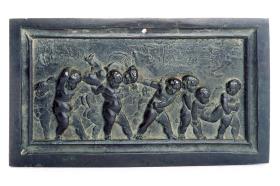
Das Relief entstand in Auseinandersetzung mit zwei in der Renaissance hochberühmten antiken Bildwerken, Teilen vom sogenannten Thron Saturns, eines größeren Ensembles von Marmorreliefs mit Amoretten (Venedig, Museo Archeologico). Dort tragen die nackten Kindergestalten eine Sense, das Attribut Saturns, auf ihren Schultern und schleppen dessen Zepter fort. In der ersten Hälfte des 15. Jahrhunderts sind diese Reliefs in Venedig nachweisbar, wo sie zahlreichen Künstlern als Studienobjekte dienten. Goethe berichtet über die Engel in der "Italienischen Reise": "Es sind Genien, welche sich mit den Attributen der Götter schleppen, freilich so schön, das es allen Begriff übersteigt."English catalogue entryNorthern Italian (Venice or Padua?)Playing Puttica. 1450-80Bronze plaquette12.4 x 22.1 cm.Berlin, Staatliche Museen, Skulpturensammlung, Inv. SKS 1024.Bode-Museum, on view.ProvenanceGeneva, Mylius collection; Florence, Stefano Bardini (1880); Berlin, Skulpturensammlung/Altes Museum (1880-1896); Berlin, Berlin, Skulpturensammlung/Neues Museum (1896-1904); Berlin, Skulpturensammlung/Kaiser-Friedrich-Museum (1904-1939); Berlin, storage (1939-1945); Merkers, storage (1945); Wiesbaden, Central Collecting Point (1945-1956); West Berlin, Skulpturensammlung/Museum Dahlem (1956-1990); Berlin, Skulpturensammlung/Museum Dahlem (1990-1997); Berlin, storage (1997-2006); Berlin, Skulpturensammlung/Bode-Museum (since 2006).AcquisitionAcquired in Florence from Stefano Bardini in 1880.BibliographyBode 1884Wilhelm Bode, “Die italienischen Skulpturen der Renaissance in den Königlichen Museen zu Berlin. III. Bildwerke des Donatello und seiner Schule”, Jahrbuch der Königlich preußischen Kunstsammlungen, V, 1884, pp. 30, 42 note 1: Donatello.Molinier 1886Émile Molinier, Les Bronzes de la Renaissance. Les plaquettes. Catalogue raisonné, Paris, Jules Rouam, 1886, I, pp. 45-46 cat. 77: school of Donatello.Bode 1894Wilhelm Bode, Denkmäler der Renaissance-Sculptur Toscanas, Munich, F. Bruckmann, 1894, II, pl. 92: Donatello.Bode 1902Wilhelm Bode, Florentiner Bildhauer der Renaissance, Berlin, Bruno Cassirer, 1902, pp. 259, 261 note 112: Donatello.Bode 1904Wilhelm Bode, Die italienischen Bronzen, 2nd edition, Berlin, Reimer, 1904, p. 50 n. 635, pl. XLIII. (reference to be checked)Schubring 1907Paul Schubring, Donatello. Des Meisters Werke in 277 Abbildungen, Stuttgart and Leipzig, Deutsche Verlags-Anstalt, 1907, p. 94: Donatello, ca. 1440.Sirén 1909Osvald Sirén, Florentinsk Renässansskultur och andra Konsthistoriska ämnen, Stockholm, Wahlström & Widstrand, 1909, p. 132: Donatello.Bode 1921Wilhelm Bode, Florentiner Bildhauer der Renaissance, Berlin, Bruno Cassirer, 1921, p. 234 fig. 141: Donatello.Planiscig 1921Leo Planiscig, Venezianische Bildhauer der Renaissance, Vienna, Anton Schroll, 1921, pp. 327-328: studies the motif, comparisons with works in Venice (San Marco), Vienna (Estense Gallery), Paris (Louvre), Florence (Bargello).Bange 1922E. F. Bange, Die Italienischen Bronzen der Renaissance und des Barock, Zweiter Teil: Reliefs und Plaketten, Berlin and Leipzig, Walter de Gruyter, 1922, pp. 39-40 cat. 296: Donatello, copy after the antique Throne of Saturn.Colasanti 1931Arduino Colasanti, Donatello, Franch trans., Paris, Crès, 1931, pl. CLVIII: Donatello.Chastel 1954 ed. 1978André Chastel, “Di mano dell’antico Prassitele”, Mélanges Lucien Febvre, II, Paris, 1954 now in: idem, Fables, forms, figures, Paris, Flammarion, 1978 II, p. 14: about the genealogy of the motif.Goldscheider 1947L. Goldscheider, Donatello, Paris, Phaidon, 1947, p. 35 fig. 95, p. 38: Donatello.Pope-Hennessy 1965John Pope-Hennessy, Renaissance Bronzes from the Samuel H. Kress Collection, London, Phaidon Press, 1965, p. 95: Venetian, late 15th-early 16th century; same workshop as the type also represented in the Berlin Collection, Inv. SKS 2121.Metz 1966Peter Metz, Bildwerke der christlichen Epochen von der Spätantike bis zum Klassizismus aus den Beständen der Skulpturenabteilung der Staatliche Museen, Stiftung Preußischer Kulturbesitz, Berlin-Dahlem, Munich, Prestel, 1966, p. 90 cat. 503: circle of Donatello.Beschi 1985Luigi Beschi, “I rilievi ravennati dei ‘troni’”, Felix Ravenna, CXXVII-CXXX, 1984-85, p. 44.Trudzinski 1986Meinholf Trudzinski, Beobachtungen zu Donatellos Antikenrezeption, Berlin, Richard Seitz & Co., 1986, p. 84 note 204, fig. 50: school of Donatello.Pfisterer 2002Ulrich Pfisterer, Donatello und die Entdeckung der Stile 1430-1445, Munich, Hirmer Verlag, 2002, pp. 207-214: follower of Donatello.Krahn 2003Volker Krahn in idem, Bronzetti veneziani. Die venezianischen Kleinbronzen der Renaissance aus dem Bode-Museum Berlin, Cologne, Dumont, 2003, pp. 32-35 cat. 1: Northern Italian, Venice?, 3rd quarter of the 15th century.CommentThis plaquette represents numerous putti playing in a landscape. Arranged like a frieze, ten putti occupy the foreground: two are carried by others, the first one wiggling and the second one unconscious and most probably drunk. In the background, among the hills and trees, at least eleven other silhouettes can be seen. Such iconography is to be connected with the bacchanals represented on Antique sarcophagi, which Renaissance artists increasingly studied during the 15th century and reinterpreted for their own works. The main source of the present plaquette is a marble relief documented since 1335 in the Church of San Vitale, Ravenna, two fragments of which have been in the public sculpture collection of Venice (now the Museo Archeologico Nazionale) since 1808-09. This structure is known as the Throne of Saturn, each pair of putti flanking an empty throne – absent in the Venetian fragments – symbolizing a divinity.The motif of the putto raising his arm behind his head, on the left foreground, was especially successful in the Veneto during the Renaissance: one can see it in a wall fountain once in the sacristy of Santa Maria dei Servi, Venice, and now in the Basilica of the Bode-Museum, Berlin (see Inv. SKS 294; and Planiscig 1921 for further comparisons). A Virgin and Child now in the Louvre (Inv. RF 1629), generally ascribed to the school of Donatello, uses the same motif (see Francesco Caglioti, “Una conferma per Andrea dell’Aquila scultore: la ‘Madonna’ di casa Caffarelli”, Prospettiva, 69, January 1993, p. 13), as does another plaquette formerly in the Berlin Sculpture Collection, lost since May 1945 and previously attributed to Donatello (see Inv. SKS 2121).This plaquette has first been directly attributed to Donatello by Bode 1884, for typological and iconographic reasons: not only was the artist’s fascination for putti well known, but Donatello was also one of the first in the Renaissance to produce bronze plaquettes. However, no stylistic comparison can confirm this attribution; even if some scholars still locate this work among the “school of Donatello” (Pfisterer 2002), it is safer to detach it from the Florentine artist and to qualify it as by a Northern Italian artist from the third quarter of the 15th century (Krahn 2003).Neville Rowley (24 February 2016)

Prophet Jesaia

Prophet Jesaia

Paarweise angeordnet standen die Propheten hoch aufgerichtet mit zurückweichendem Ober- und vorgeschobenem Unterkörper (außer dem ganz rechts platzierten), mit vorgeneigtem Kopf und ehemals weit auf den Vorplatz der Kirche hinaus gerichteten Blick, in den Händen ursprünglich Schriftrollen. Sie tragen jeweils unterschiedlich drapierte bodenlange Gewänder und Mäntel sowie verschiedene Kopfbedeckungen. Physiognomie und Gestik sind stark differenziert und vermitteln das Bild ausgeprägter Individuen, die erfüllt sind von der Bedeutungsschwere ihrer eschatologischen Vision. In der Forschung hat sich die durch kein Attribut oder zwingendes ikonografisches Argument gestützte Bezeichnung als Jesaia, Jeremias, Hezekiel und Daniel (von links nach rechts) eingebürgert, an der hier zum besseren Verständnis festgehalten werden soll. Inhaltlich sind die Propheten den beiden ineinander verschränkten Hauptthemen des Trierer Westportals, der Heilsgeschichte und der Verehrung Marias als Braut Christi, zugeordnet. Sie sind Vertreter des Alten Bundes, durch ihre visionäre Vorausschau auf die Geburt Christi zudem Verkünder der Heils und Zeugen des Jüngsten Gerichts. Angeregt durch scholastische Lehren treten die einzelnen Propheten seit dem frühen 13. Jahrhundert auch in der Kunst zunehmend als Individuen auf, die durch Inschriften, die Wiedergabe spezieller Szenen der jeweiligen Weissagungen oder auch einen bestimmten Figurentyp (spätestens am Straßburger Münster, um 1270/80) erkennbar werden.Die Figuren befanden sich unter Baldachinen an den Ecken der Westfassade der Trierer Liebfrauenkirche. Das Portal besaß ehemals sechs Gewändefiguren, von denen sich lediglich Johannes der Evangelist (Identifizierung unsicher), Ecclesia und Synagoge erhalten haben. In den fünf Archivolten darüber sind von innen nach außen Engel als Repräsentanten des Himmels, Päpste und Bischöfe als Zeugen des irdischen Wirkens der Kirche, apokalyptische Greise mit Musikinstrumenten und die Klugen und Törichten Jungfrauen dargestellt. Im Tympanon sind zentral die thronende Maria mit Kind, links die Heiligen Drei Könige und außen die kleinere Hirtenverkündigung, rechts die Darbringung im Tempel und außen klein der Kindermord zu sehen. Im zweiten Geschoss befindet sich zwischen den Propheten eine hohe Blendnische, in die ein dreibahniges Fenster mit Sechspassrosette eingeschrieben ist; seitlich des Fensters stehen Gabriel und Maria. Ein weiteres, höheres Fenstergeschoss wird mit einem Gesims abgeschlossen, auf dem sich ein Giebel mit den übergroßen Figuren des Gekreuzigten zwischen Maria und Johannes erhebt.Neu im deutschsprachigen Gebiet ist nicht nur die Ausdehnung des Skulpturenschmucks weit über die Portalzone hinaus, sondern auch die unmissverständliche Bezugnahme von Gestik und Blicken auf den Betrachter. Dieses Prinzip wurde an den großen Fassaden französischer Kathedralen mit ihren umfangreichen Figurenprogrammen erstmals realisiert, insbesondere in Reims, einem Bau, der in vielerlei Hinsicht vorbildlich für die Liebfrauenkirche war. Um 1235, zum Zeitpunkt des Baubeginns in Trier, standen von der Kathedrale des benachbarten Erzbistums bereits die Chorpartien und Fassaden, an den Querhäusern bis zum Rosengeschoss. Die leicht variierte Wiederholung des „Reimser Fensters“ an der Trierer Liebfrauenkirche zeigt, dass die neuesten Lösungen aus der Champagne unmittelbar rezipiert wurden. Die Westfassadenskulpturen könnten um 1240 entstanden sein, was gut zu der Überlegung einer Übersiedlung von Bildhauern aus Reims passen würde, wo die vergleichbaren Arbeiten um 1230 entstanden sind.(Auszug aus: Tobias Kunz, Bildwerke nördlich der Alpen. 1050 bis 1380. Kritischer Bestandskatalog der Berliner Skulpturensammlung, Petersberg, Michael Imhof Verlag 2014)

Beweinung Christi (4 teilig)

Beweinung Christi (4 teilig)

Die aus Einzelfiguren zusammengesetzte Figurengruppe zeigt die Beweinung Christi - ein Motiv, das in den Evangelien nicht erwähnt wird. Der vom Kreuz abgenommene Leichnam Christi lagert ausgestreckt mit halb aufgerichtetem Oberkörper über dem Schenkel der seitlich nach hinten sinkenden Maria. Sie ist in ein weites Kleid und in ein über ihr Haupt gezogenes Tuch gehüllt, Voll Schmerz ringt sie mit den von sich gestreckten Händen, ihre Augen sind fast geschlossen. In Ohnmacht fallend, wird sie von Johannes aufgefangen, der von rechts herantritt und die Komposition auf dieser Seite abschließt. Diese Dreiergruppe bildet von den Füßen Christi ausgehend bis zum Kopf des Lieblingsjüngers Jesu ein aufsteigendes Dreieck, das links von der knienden Maria Magdalena ausbalanciert wird. Die von Jesus bekehrte Sünderin benetzt mit ihren Tränen den Leib Christi und salbt diesen mit einem Tuch, das sie in ihrer erhobenen Linken hält.Die Dramatik des Geschehens wird nicht allein durch Gesten und Mimik veranschaulicht, sondern vor allem auch durch die Gewänder, die mit ihren bewegten Draperien die Seelenzustände der jeweiligen Personen widerzuspiegeln scheinen. Eingebettet ist darin der nackt lagernde Leichnam des Erlösers, dessen schwerer, lebloser Körper in einem fließenden S-Schwung dem Betrachter zugewandt ist. Hier greift der Bildschnitzer italienische Vorbilder des 16. Jahrhundert und frühen 17. Jahrhunderts auf, bei denen die Christusfigur in einer ähnlich aufsteigenden Torsion komponiert ist. Die für die private Andacht konzipierte Gruppe darf dem venezianischen Bildhauer Giovanni Giuliano oder einem seines engsten Umkreises angehörigen Mitarbeiters zugeschrieben werden. Giuliano ging bereits in jungen Jahren nach München, wo er in den 1680er-Jahren in der Werkstatt des Bildhauers Andreas Faistenberger tätig war. Anschließend zog er nach Wien. Die letzten 33 Jahre lebte er als Laienbruder im Stift Heiligenkreuz, wo er mit vielen Mitarbeitern zahlreiche Werke für das Stift schuf. In diese Zeit fällt auch die Gruppe der Beweinung Christi. Kennzeichnend sind für ihn Ensembles, bei denen sich die Einzelfigur als rhythmisch bewegte Silhouette der Harmonie des Ganzen einzufügen hat. Auffallend ist zugleich, dass die leicht fließende Kontur der Komposition immer an eine Fläche gebunden ist und somit nur eine bestimmte Ansicht zulässt.