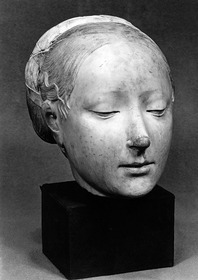
Putto mit Tamburin
Ident. Nr.: 2653
ObjID: obj:868091

Fotonachweis: Staatliche Museen zu Berlin, Skulpturensammlung und Museum für Byzantinische Kunst / Antje Voigt CC BY-SA 4.0
Details (Expert)
- Beteiligte
- Datierung
- Datierung: 1429Datierung engl.: 1429
- Systematik/Art
- Weitere Titel
- Putto mit TamburinÜbersetzung: Putto with Tambourine
- Material / Technik
- Bronze mit Resten von Vergoldung
- Abmessungen
- Höhe x Breite x Tiefe: 36,2 x 14,7 x 16,2 cmGewicht: Skulptur 7,92 kgGewicht: Marmorsockel 1,8 kg
- Erwerbung
- 1902 Wilhelm von Bode (Schenkung)
- Permalink
- https://id.smb.museum/object/868091
Objektbeschreibung
Donatello
Dancing putto with a Tambourine
1428-29
Bronze with traces of gilding
Height: 36 cm
Berlin, Staatliche Museen, Skulpturensammlung, Inv. SKS 2653.
Bode-Museum, on view.
Provenance: Siena, Cathedral, Font of the Baptistery (1429-before 1687); London, Durlacher Brothers (Murray Marks; 1902); Berlin, Skulpturensammlung/Neues Museum (1902-1904); Berlin, Skulpturensammlung/Kaiser-Friedrich-Museum (1904-1939); Berlin, storage (1939-1945); Merkers, storage (1945); Wiesbaden, Central Collecting Point (1945-1956); West Berlin, Skulpturensammlung/Museum Dahlem (1956-1990); Berlin, Skulpturensammlung/Museum Dahlem (1990-1997); Berlin, storage (1997-2006); Berlin, Skulpturensammlung/Bode-Museum (since 2006).
Acquisition
Gift of Wilhelm Bode, 1902. Acquisition file n°1087/02 in the Zentralarchiv der Staatlichen Museen zu Berlin.
Exhibitions:
Italian Renaissance Sculpture in the Time of Donatello, Detroit, The Detroit Institute of Arts, 23 October 1985-5 January 1986 and Fort Worth, Kimbell Museum of Art, 22 February-5 April 1986, cat. 22.
Donatello e i suoi, Florence, Forte del Belvedere, 15 June-7 September 1986, cat. 27.
Kaiser Friedrich III. und sein Museum, West Berlin, Gemäldegalerie, 15 June-24 July 1988.
Von allen Seiten schön, Berlin, Altes Museum, 31 October 1995-28 January 1996, cat. 1
Giovinezza di Michelangelo, Florence, Palazzo Vecchio and Casa Buonarroti, 6 October 1999-9 January 2000, cat. 23.
Ansichtsache. Das Bodemuseum Berlin im Liebighaus Frankfurt, Francfort, Liebighaus, 2002.
In the Light of Apollo. Italian Renaissance and Greece, Athens, National Gallery and Alexandros Souzos Museum, 22 December 2003-31 March 2004, cat. II.1.
Da Jacopo della Quercia a Donatello. Le arti a Siena nel primo Rinascimento, Siena, Santa Maria della Scala, Opera della Metropolitana, Pinacoteca Nazionale, 26 March-11 July 2010, cat. C.3.
Bronze, London, Royal Academy of Arts, 15 September-9 December 2012, cat. 82.
Comment
A putto or spiritello is a winged baby originally present in the iconography of pagan Antiquity; at the beginning of the 15th century, Tuscan artists began to reuse intensively the motif, which is often integrated into Christian representations. This was formerly the case for this putto, once crowning the Baptismal Font of Siena Cathedral together with five other statuettes. The work has been celebrated as one of the first small bronzes (bronzetti) of the Italian Renaissance (Pope-Hennessy, 1993, p. 86), which is not, strictly speaking, accurate, as it was not designed as an independent sculpture but as part of a global decoration (see Draper 1992). The Dancing putto with a Tambourine is, however, one of the most important bronzes of the Early Renaissance – and of Donatello’s career.
Standing on a shell, the putto holds a tambourine in his left hand, which he is about to hit with the other hand. The suspension of this movement is enhanced by the instability of the pose: not only is the equilibrium of the feet of the putto very unstable on the concave shell, but the whole body is twisting around a central axis. It is as if the boy intended to play his instrument for someone behind him: indeed, he was part of a group of three bronzes. The Berlin putto was in the left position, to the right was a trumpeter, also playing in direction of the center, where a dancing putto stood (see Lányi 1939). The pose of the child, with his legs turned toward the right while his arms are toward the left, has consistently been compared to the “figura serpentinata” admired during the mannerist period in the 16th century (Janson 1957; Krahn 1995a). If some antique models have been proposed as an inspiration for this statuette (see Balcarres 1903; Janson 1957), no direct example is entirely convincing – Donatello is known to have taken inspiration from Antiquity, but never to have copied it passively.
Like the two other bronzes mentioned above, the putto can be attributed to Donatello and traced back to a 1429-30 documented contribution to the Siena Baptistery Font (for which Donatello also made the relief of the Feast of Herod and two Virtues, in a similar gilt-bronze technique). While the other works by Donatello are still in situ, the Berlin statuette was missing as early as 1687 (Vittorio Lusini, Il San Giovanni di Siena e i suoi restauri diretti dal Prof. Agenore Socini, Florence, Alinari, 1901, pp. 112-114). Another very similar putto, although never gilt like the others and whose shell base is not adorned with a wreath, was part of the Medici collections since the 16th century and is preserved in the Museo Nazionale del Bargello; it has been recognized by Caglioti 1993 as a prototype made by Donatello for the Siena Font, but never put in place. On the Font, the three other putti were modeled and cast by Giovanni di Turino; two of them are still in situ (the last one is missing).
The work was acquired in 1902, when Wilhelm Bode bought it personally in London from the dealer Murray Marks (and his gallery Burlasker Brothers), and then gave it to the Berlin Museums. Bode immediately attributed the work to Donatello and identified its provenance; it is not clear what Marks thought of the sculpture – Williamson 1919 affirms that he had identified its author and provenance and tried in vain to convince the authorities of Siena to acquire it, but this needs further demonstration (interestingly, Bode 1922 mentions the acquisition in his first memoirs, but not in his more complete book Mein Leben, published posthumously in 1930). The attribution to Donatello has almost never been challenged (only Crutwell 1911 doubted this paternity, while Paoletti 1979 found differences of casting and chasing with the other figures in situ, arguing that the work was cast and chased in Siena, an opinion quite unconvincing).
Between 1404 and 1407, the young Donatello had been trained in the casting of bronze in the studio of Lorenzo Ghiberti. In the early 1420s, he had produced the imposing statue of the St Louis of Toulouse for a niche on the outside of Orsanmichele. Even though the technique of the latter sculpture was far from perfect, Donatello greatly improved through this work his knowledge and ability in bronze casting. The first bronze works for the Siena Font are extremely well conducted, as is the case for our putto, cast in full (Krahn 1995a). Some direct connections of design can be drawn with works by Donatello in different materials, such as the strangely similar gaze of the Marzocco in the Museo Nationale del Bargello (1419-20), or the profile of the left executioner in the Flagellation once in Berlin (see Inv. SKS 1979). The treatment of the wings recurs in another work related to Donatello, the Sprite from the Metropolitan Museum in New York (Inv. 1983.356).
The original presence of six putti above the Siena Font can be explained as purely decorative, as was the case with the first instance of this motif, the spiritelli on the tomb of Ilaria del Carretto carved by Jacopo della Quercia in 1406 for the Cathedral of Lucca (Caglioti 2004 also mentioned as a direct source for Donatello the decorative angels from the Fonte Gaia made by Jacopo for the city of Siena). Donatello had already used such motifs on top of the tomb of the Cardinal Rinaldo Brancacci in Sant’Angelo a Nilo in Naples, and would do so recurrently during the rest of his career, especially after his documented stay in Rome (1431-32). The putti or spiritelli carried a general connotation of eternal life appropriate for a funerary monument, but also a Baptistery Font, given that the great majority of the baptized were newborn children; the high infant mortality may have given many parents the feeling that their own children were in some way protected by these reassuring babies, dancing and playing music (see Donati 2010; for other, less convincing interpretations, see Bacci, 1929; Paoletti 1967 ed. 1979; Paoletti 1977).
Literature
Bode 1902a
Wilhelm Bode, Florentiner Bildhauer der Renaissance, Berlin, Bruno Cassirer, 1902, pp. 259, 260 fig. 111: Donatello.
Bode 1902b
Wilhelm Bode, “Florentiner Bronzestatuetten in den Berliner Museen”, Jahrbuch der Königlich preussischen Kunstsammlungen, XXIII, 1902, pp. 75-79: Donatello, from the Font of the Siena Cathedral; six putti in total, just one is missing in Siena sic; bought from Murray Marks, who had recognized its quality when the statuette was evaluated for 2 pounds; dark patina over the gilding.
Balcarres 1903
Lord Balcarres, Donatello, London and New York, Duckworth & Co. and Charles Scribner’s Sons, 1903, p. 114: “an invaluable acquisition”. Compared to classical sculptures (British Museum, Inv. 1147; and Eros springing forward in the Forman collection, dispersed in 1899).
Bode 1904
Wilhelm Bode, “Musée de Berlin. Statuettes de bronze italiennes récemment acquises”, Les Arts, n°29, May 1904, p. 9 fig. II, p. 10: Donatello; two patinas, one gilt, the other darker.
Schottmüller 1904
Frida Schottmüller, Donatello. Ein Beitrag zum Verständnis seiner künstlerischen Tat, Munich, F. Bruckmann, 1904, pp. 55, 76, 84 note 1, p. 122.
Schubring 1905
Paul Schubring, “Italienische Plastik”, Zeitschrift für bildende Kunst, new series, XVI, 1905, p. 57.
Bode 1907
Wilhelm Bode, The Italian Bronze Statuettes of the Renaissance, London, H. Grevel & Co., 1907, p. 9, pl. VI.
Schubring 1907
Paul Schubring, Donatello. Des Meisters Werke in 277 Abbildungen, Stuttgart and Leipzig, Deutsche Verlags-Anstalt, 1907, pp. 29, 195: the finest of all the putti of the Siena Font.
Bertaux 1910
Émile Bertaux, Donatello, Paris, Plon, 1910, p. 86.
Knapp n. d. 1910
Friedrich Knapp, Die Italienische Plastik vom XV. bis XVIII. Jahrhundert, Berlin, Fischer & Franke, n. d. 1910, p. 22 and pl. 28a.
Cruttwell 1911
Maud Cruttwell, Donatello, London, Methuen, 1911, p. 62: “it has only to be compared with the genuine putto i.e. putti of the Siena Font to prove that it is not the work of Donatello”.
Goldschmidt 1914
Fritz Goldschmidt, Die italienischen Bronzen der Renaissance und der Barock. Erster Teil: Büsten, Statuetten und Gebrauchsgegenstände, Berlin, Georg Reimer, 1914, pp. 6-7 cat. 20, pl. 9.
Schottmüller 1918
Frida Schottmüller, Bronze-Statuetten und Geräte, Berlin, Richard Carl Schmidt & Co., 1918, pp. 75-76.
Williamson 1919
G. C. Williamson, Murray Marks and his Friends. A Tribute of Regard, London and New York, John Lane, 1919, pp. 26-27: bought by Murray Marks at a dealer’s in Bond Street; Marks connected it with the Siena Font and attributed it to Donatello, but he “was not to persuade the Siena authorities to obtain and restore it, although he tried his utmost to do so, and in consequence the figure is now in the chief museum in Berlin”.
Bode 1921
Wilhelm Bode, Florentiner Bildhauer der Renaissance, Berlin, Bruno Cassirer, 1921, p. 233 fig. 140: Donatello.
Schottmüller 1921
Frida Schottmüller, Bronze Statuetten und Geräte, Berlin, Richard Carl Schmidt, 1921, p. 91.
Bode 1922a
Wilhelm Bode, Die Italienische Plastik, 7th ed., Berlin and Leipzig, Vereinigung wissenschaftlicher Verleger and De Gruyter, 1922, p. 68 fig. 31: Donatello.
Bode 1922b
Wilhelm von Bode, Fünfzig Jahre Museumsarbeit, Bielefeld and Leipzig, Velhagen & Klassing, 1922, pp. 50-51 (1922b): the most outstanding statuette of the Berlin collection; about the acquisition for 400 pounds from Murray Marks, who thought of it as at least close to Donatello; the sculpture was thought a fake and Marks had bought it for 50 pounds.
Wulff 1922
Oskar Wulff, Donatello, Leipzig, E. A. Seemann, 1922, p. 11, fig. 25.
Bode 1923
Wilhelm von Bode, Die italienischen bronzestatuetten der Renaissance, Berlin, Bruno Cassirer, 1923, pl. 3: Donatello.
Bacci 1929
Peleo Bacci, Jacopo della Quercia, 1929, pp. 242-49, 274. (reference to be checked)
Bode 1930
Bode, Die Italienische Bronze des Kaiser Friedrich Museums, 1930, cat. 24. (reference to be checked)
Ormsby Gore 1930
William Ormsby Gore, Florentine Sculptors of the Fifteenth Century, London, MacMillan, 1930, p. 140: Donatello.
Planiscig 1930
Leo Planiscig, Piccoli bronzi italiani del Rinascimento, Milan, Fratelli Treves, 1930, p. 4 and pl. III fig. 3.
Colasanti 1931
Arduino Colasanti, Donatello, French trans., Paris, Crès, 1931, pl. LV: Donatello, 1428.
Donath 1933
A. Donath, “Wie Bode gekauft hat”, Neue freie Presse, 9 September 1933. (reference to be checked)
Bange 1934
E. F. Bange, Die Italienischen Bildwerke im Kaiser-Friedrich-Museum, Berlin, Verlag für Kunstwissenschaft, 1934, p. 23.
Lányi 1939
Jenö Lányi, “Donatello’s Angels for the Siena Font: a Reconstruction”, The Burlington Magazine, LXXV, n°189, October 1939, pp. 142-151: numbers and orders the three putti by Donatello for the Siena Font, with the one in Berlin on the left side, the trumpeter on the right side and the dancing one in the center.
Planiscig 1939
Leo Planiscig, Donatello, Vienna, Anton Schroll, 1939, pp. 14, 35, fig. 30.
Buscaroli 1942
Rezio Buscaroli, L’arte di Donatello, Florence, Monsalvato, 1942, p. 142 cat. 28: Donatello.
Goldscheider 1947
L. Goldscheider, Donatello, Paris, Phaidon, 1947, p. 20.
Planiscig 1947
Leo Planiscig, Donatello, Florence, Arnaud Editore, 1947, p. 47: “è (o era?) al Museo di Berlino”.
“Editorial…” 1954
“Editorial. Italian Sculpture in the Berlin Museums: Losses and Survivals”, The Burlington Magazine, XCVI, n°612, March 1954, p. 69: thought to have been destroyed during the war, until the exhibition in Wiesbaden during the summer of 1953.
Janson 1957
H. W. Janson, The Sculpture of Donatello, Princeton, Princeton University Press, 1957, II, pp. 73-75.
Metz n. d. 1957
Peter Metz, Europäische Bildwerke von der Spätantike bis zum Rokoko aus den Beständen der Skulpturen-Abteilung der Ehem. Staatliche Museen Berlin-Dahlem, Munich, Prestel, n. d. 1957, p. 49 cat. 237, pl. 36.
Grassi 1958
Luigi Grassi (ed.), Tutta la scultura di Donatello, Milan, Rizzoli, 1958, p. 67: Donatello, 1428.
Metz 1964-65
Peter Metz, “Das neue Skulpturenmuseum in Dahlem”, Jahrbuch der Stiftung preußischer Kulturbesitz, III, 1964-65, p. 110.
Metz 1966
Peter Metz, Bildwerke der christlichen Epochen von der Spätantike bis zum Klassizismus aus den Beständen der Skulpturenabteilung der Staatliche Museen, Stiftung Preußischer Kulturbesitz, Berlin-Dahlem, Munich, Prestel, 1966, p. 89 cat. 497, pl. 74.
Carli 1967
Enzo Carli, Donatello a Siena, Rome, Editalia, 1967, pp. 19-20, pl. XXI.
Paoletti 1967
John T. Paoletti, The Siena Baptistery Font. A Study of Early Renaissance Collaborative Program. 1416-1434, Ph.D. (Yale University, 1967), New York and London, ed. 1979, pp. 131-133: Donatello; differences with the Siena putti; the casting and chasing were done in Siena by Tommaso di Paolo.
Janson 1968
Janson, “Donatello and the Antique”, in Donatello e il suo tempo, 1968, p. 82. (reference to be checked)
Hartt 1973
Frederick Hartt, Donatello. Prophet of Modern Vision, New York, 1973, pp. 161-162.
Paoletti 1977
John T. Paoletti, “Il Tabernacolo del Fonte Battesimale e l’iconografia medioevale”, in Giulietta Chelazzi Dini (ed.), Jacopo della Quercia fra Gotico e Rinascimento, symposium papers (Siena, Facoltà di Lettere e Filosofia, 2-5 October 1975), Florence, Centro Di, 1977, p. 131: the putti of the Siena Font are identified with David’s musicians (Psalm 150).
Pope-Hennessy 1977 ed. 1980
John Pope-Hennessy, “Donatello and the Bronze Statuette”, Apollo, CV, n°179, January 1977 now in: idem, The Study and Criticism of Italian Sculpture, New York and Princeton, The Metropolitan Museum of Art and Princeton University Press, 1980, p. 129.
Bode 1980
Wilhelm Bode, The Italian Bronze Statuettes of the Renaissance, James D. Draper ed., New York, De Reinis, 1980, pl. VI.
Poeschke 1980
Joachim Poeschke, Donatello. Figur und Quadro, Munich, Wilhelm Fink, 1980, pl. XIX fig. 29.
Sachs 1984
Hannelore Sachs, Donatello, East Berlin, Henschelverlag, 1984, chap. 17.
Gersdorff n. d. 1985
Dagmar von Gersdorff, Kinderbildnisse aus vier Jahrtausenden aus den Sammlungen der Stiftung Preußischer Kulturbesitz Berlin, West Berlin, Frölich & Kaufmann, n. d. 1985, p. 148.
Herzner 1985
Volker Herzner in Italian Renaissance Sculpture in the Time of Donatello, exh. cat. (Detroit, The Detroit Institute of Arts, 23 October 1985-5 January 1986 and Fort Worth, Kimbell Museum of Art, 22 February-5 April 1986), Detroit, The Detroit Institute of Arts, 1985, pp. 123-124 cat. 22.
Boucher 1986
Bruce Boucher, “Detroit and Fort Worth. Sculpture in the time of Donatello”, The Burlington Magazine, CXXVIII, n°994, January 1986, p. 67.
Herzner 1986
Volker Herzner in Alan Phipps Darr and Giorgio Bonsanti (eds.), Donatello e i suoi, exh. cat. (Florence, Forte del Belvedere, 15 June-7 September 1986), Detroit and Florence, The Detroit Institute of Arts, La Casa Usher and Arnaldo Mondadori Editore, 1986, pp. 138-139 cat. 27.
Bloch et al. 1988
Peter Bloch et al., Kaiser Friedrich III. und sein Museum, exh. cat. (West Berlin, Gemäldegalerie, 15 June-24 July 1988), West Berlin, Kaiser-Friedrich-Museums Verein, 1988, pp. 20-21.
Darr 1989
Alan Phipps Darr, “The Donatello Exhibition at Detroit and Florence: Results, Perspectives, and New Directions”, in Donatello-Studien, Munich, Bruckmann, 1989, p. 16: superb.
Schlegel 1989
Ursula Schlegel, Italienische Skulpturen. Ein Gang durch die Berliner Skulpturengalerie, West Berlin, Mann, 1989, p. 14.
Avery 1991
Charles Avery, Donatello. Catalogo complete delle opere, Florence, Cantini, 1991, pp. 45-46 cat. 26: the shell refers to the moment when Christ is baptized.
Draper 1992
James David Draper, Bertoldo di Giovanni, Sculptor of the Medici Household. Critical Reappraisal and Catalogue Raisonné, Columbia and London, University of Missouri Press, 1992, p. 30: not an independent bronze.
Pope-Hennessy 1993
John Pope-Hennessy, Donatello Sculptor, New York, London and Paris, Abbeville Press, 1993, pp. 86-87, 329 note 10: modelled and cast in Siena.
Rosenauer 1993
Artur Rosenauer, Donatello, Milan, Electa, 1993, pp. 77, 99-102, cat. 15c: “orthogonal” pose; anticipates the putti of the St Louis of Toulouse for Orsanmichele and those (not autograph) for the Brancacci Tomb in Sant’Angelo a Nilo, Naples.
Knuth 1995
Michael Knuth, “Zu Wilhelm von Bode als Mäzen der Skulpturensammlung”, in Wilhelm von Bode. Museumsdirektor und Mäzen, Berlin, Kaiser-Friedrich-Museums-Verein, 1995, pp. 66, 71.
Krahn 1995a
Volker Krahn in idem (ed.), Von allen Seiten schön. Bronze der Renaissance und des Barock, exh. cat. (Berlin, Altes Musem, 31 October 1995-28 January 1996), Offenbach, Volker Huber, 1995, p. 130 cat. 1: prefigures the “figura serpentinata”; full cast.
Krahn 1995b
Volker Krahn, “‘Ein ziemlich kühnes Unterfangen…’. Wilhelm von Bode als Wegbereiter der Bonzeforschung, seine Erwerbungen für der Berliner Museen und seine Beziehungen zu Sammlern”, in idem (ed.), Von allen Seiten schön. Bronze der Renaissance und des Barock, exh. cat. (Berlin, Altes Musem, 31 October 1995-28 January 1996), Offenbach, Volker Huber, 1995, p. 41.
Draper 1999
James David Draper in Kathleen Weil-Garris Brandt (ed.), Giovinezza di Michelangelo, exh. cat. (Florence, Palazzo Vecchio and Casa Buonarroti, 6 October 1999-9 January 2000), Florence and Milan, Skira, 1999, p. 252 cat. 23: maybe Donatello kept a plaster cast of his bronze, which was difficult to see in Siena, because it directly influenced the anonymous author of the Young Mercury in the Metropolitan Museum of Art, New York (Inv. 1983.356), and the Young Archer by Michelangelo in the French Institute, New York.
Caglioti 2000
Francesco Caglioti, Donatello e i Medici. Storia del ‘David’ e della ‘Giuditta’, Florence, Leo S. Olschki Editore, 2000, I, p. 161 note 37, p. 162 note 41, p. 167 note 60; p. 180, p. 415 note 44.
Katalog der Originalabgüsse… 2000
Katalog der Originalabgüsse. Heft 6. Christliche Epochen. Spätantike. Byzanz. Italien. Freiplastik. Reliefs. Bronzestatuetten, Berlin, Staatliche Museen zu Berlin, 2000, cat. 2161.
Luchs 2001
Alison Luchs, “The ‘Winged Woman Holding a Torch’: a Donatellesque Bronze from Quattrocento Tuscany”, in Debra Pincus (ed.), Small Bronzes in the Renaissance, symposium papers (Washington DC, National Gallery of Art, 4-5 December 1998), Washington DC, New Haven and London, National Gallery of Art and Yale University Press, 2001, p. 29 note 4.
Taxer 2002
Christine Taxer, “Eros im Baptisterium – eine heidnische Angriff auf des Christentum?”, in Herbert Beck and Hartmut Krohm (eds.), Ansichtsache. Das Bodemuseum Berlin im Liebighaus Frankfurt. Europäische Bildhauerkunst von 800 bis 1800, H. Beck and H. Krohm (eds.), Frankfurt, 2002, pp. 185-193.
Wainwright 2002
Clive Wainwright, “‘A Gatherer and Disposer of other men’s stuff’. Murray Marks, connoisseur and curiosity dealer”, Journal of the History of Collections, XIV, n°1, 2002, p. 171: about the acquisition.
Caglioti 2003
Francesco Caglioti, “Donatello e il Fonte Battesimale di Siena. Per una rivalutazione dello ‘Spiritello danzante’ nel Museo Nazionale di Firenze”, Prospettiva, 110-111, April-July 2003, pp. 18-29.
Caglioti 2004
Francesco Caglioti in Mina Gregori (ed.), In the Light of Apollo. Italian Renaissance and Greece, exh. cat. (Athens, National Gallery and Alexandros Souzos Museum, 22 December 2003-31 March 2004), Cinisello Balsamo, Silvana Editoriale, 2004, pp. 195-196 cat. II. 1: the motif of the putto comes from Jacopo della Quercia (Tomb of Ilaria del Carretto; Angels from the Fonte Gaia); “astonishing instability” of the Berlin putto.
Grisko 2006 ed. 2007
Michael Grisko, “Die Ausstellung: Einblicke in die vier Sammlungen”, in Carola Wedel (ed.), Das Bode-Museum. Schatzkammer der Könige, Berlin, Jaron Verlag, 2006 (2nd ed. 2007), p. 101.
Knuth 2006
Michaël Knuth in Skulpturensammlung im Bode-Museum, Munich et al., Prestel, 2006, pp. 124-125.
Ciaroni 2007
Andrea Ciaroni, Dai Medici al Bargello. Volume secondo. I Bronzi del Rinascimento. Il Quattrocento, Maastricht, Altomani & Sons, 2007, p. 82.
Fattorini 2008
Gabriele Fattorini, Jacopo della Quercia e l’inizio del Rinascimento a Siena, Florence, Il Sole 24 Ore e E-ducation.it, 2008, pp. 196-199, 208-209.
Donati 2010
Gabriele Donati in Max Seidel et al. (eds.), Da Jacopo della Quercia a Donatello. Le arti a Siena nel primo Rinascimento, exh. cat. (Siena, Santa Maria della Scala, Opera della Metropolitana, Pinacoteca Nazionale, 26 March-11 July 2010), Milan, Federico Motta Editore, 2010, p. 382-83; cat. C.3: the shell is related to the baptism; symbolic link between the baptized children in the Font and the putti dancing above.
“A Gold Medal for Bronze” 2012
“A Gold Medal for Bronze”, 13 November 2012: (https://notestothemilkman.wordpress.com/2012/11/13/a-gold-medal-for-bronze/): “Wouldn’t life be boring if we all liked the same thing? Before going down to see the Bronze exhibition at the Royal Academy last week, the Management and I watched the Culture Show episode which included a look at the exhibition. Andrew Graham-Dixon was accompanied by Gallery owner Danny Katz, who has been buying and selling sculpture for over forty years. In front of ‘Putto with Tambourine’ (1429) by Donatello, Katz was in ecstasy. ‘This is the one object I totally covet.’ ’You want to take it home?’ asked Graham-Dixon. ‘I couldn’t! I’m only a mere man, a mortal. I couldn’t live with something like this. This is great art.’ My reaction? It was okay but it didn’t really do much for me.”
Ekserdjian 2012
David Ekserdjian in idem (ed.), Bronze, exh. cat. (London, Royal Academy of Arts, 15 September-9 December 2012), London, Royal Academy of Arts, 2012, p. 267 cat. 82.
Bormand 2013
Marc Bormand, “Gli ‘spiritelli’ del Rinascimento”, in idem and Beatrice Paolozzi Strozzi (eds.), La primavera del Rinascimento. La scultura e le arti a Firenze 1400-1460, exh. cat. (Florence, Palazzo Strozzi, 23 March-18 August 2013 and Paris, Musée du Louvre, 26 September 2013-6 January 2014), Florence, Mandragora, 2013, pp. 112-113.
Krahn 2013
Volker Krahn, “Wilhelm von Bode and his Engagement with two Bronze Groups of ‘Hercules and Anteaeus’”, in Peta Motture, Emma Jones and Dimitrios Zikos (eds.), Carvings, Casts & Collectors. The Art of Renaissance Sculpture, symposium papers (London, Victoria and Albert Museum, 12-13 November 2010), London, V&A Publication, 2013, p. 158 note 2.
Savoy 2014
Bénédicte Savoy, “Vom Faustkeil zur Handgranate”. Filmpropaganda für die Berliner Museen 1934-1939, Cologne, Weimar and Vienna, Böhlau, 2014, pp. 12, 25, 135 note 73, pp. 150, 153, 163: quotes an article from Film-Kurier, 14 juin 1939, which speaks of “the famous angel”; the putto appears in a film by Hans Cürlis, Schatzkammer Deutschland (1939).
Neville Rowley (24 May 2016)
Letzte Aktualisierung: 29.10.2026
Kontakt
Einrichtung:
Skulpturensammlung und Museum für Byzantinische Kunst
E-Mail:
sbm@smb.spk-berlin.de