Logo

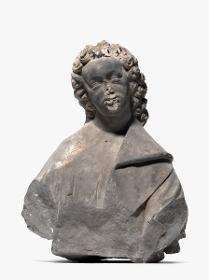
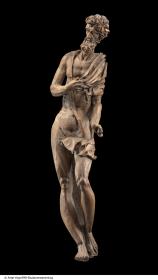
Evangelist Markus vom Münnerstädter Retabel

Ident. Nr.: 404

ObjID: obj:869122

Details (Expert)

Beteiligte
Tilman Riemenschneider (7.7.1531),
Bildhauer*in
Datierung
Datierung: 1490-1492
Systematik/Art
Geografische Bezüge
Entstehungsort stilistisch: Deutschland
Material / Technik
Lindenholz
Abmessungen
Höhe x Breite x Tiefe: 73,5 x 40 x 25 cm

Objektbeschreibung

Die Evangelisten vom Münnerstädter Altar
Der Altar, den Riemenschneider 1490-1492 für die Pfarrkirche St. Maria Magdalena in Münnerstadt anfertigte, ist ein Schlüsselwerk in der Entwicklung der spätmittelalterlichen Skulptur. Er gehörte zu den frühesten Retabeln, die ohne Farbfassung geliefert wurde, aber die Abwesenheit von Polychromie scheint als störend empfunden gewesen zu sein und 1504-1506 wurde der Nürnberger Bildhauer Veit Stoss beauftragt, den Altar zu vergolden und bemalen. Der Altar wurde zwischen 1649 und 1653 auseinander genommen und umgestaltet. Mehrere skulpturalen Elemente wurden entfernt und fanden ihren Weg letztendlich in öffentliche Sammlungen. In den frühen 1980er Jahren wurden die Teile, die in Münnerstadt geblieben waren, in eine moderne Umrahmung im Kirchenraum installiert, damit sie wieder auf der richtigen Höhe und im richtigen Licht präsentiert werden konnten. Kopien der Skulpturen in München und Berlin wurden später dem Ensemble hinzugefügt.


Das Bildprogramm thematisierte das Leben der Hl. Maria Magdalena, Patronin der Kirche. Als reuende Kurtisane, die sich Gott gewandt hatte, diente Sie als Vorbild, dass sogar Sünder Heiligen werden können und dass die Hoffnung auf Erlösung jedem zusteht. Im Schrein des Münnerstädter Altars wurde sie, zwischen dem Hl. Kilian und der Hl. Elisabeth von Thüringen, von Engeln zum Himmel getragen. Im Aufzug standen die Muttergottes und Johannes der Evangelist an beiden Seiten der Dreifaltigkeit; noch höher stand Johannes der Täufer. Die Predella enthielt die vier Evangelisten. Auf den Flügeln waren vier Reliefs mit Szenen aus der Legende der Hl. Maria Magdalena zu sehen: links Christus im Hause Simons über Die Erscheinung Christi vor Maria Magdalena und rechts die letzte Kommunion von Maria Magdalena über einer Darstellung ihrer Grablegung. Die Gesamthöhe des Retabels betrug ca. 13 Meter.


Die Evangelisten in der Predella bildeten das theologische und visuelle Fundament für den Altar, dessen vereinheitlichende Thema die Erlösung durch Christi Tod ist. Die Aneinanderreihung der Figuren von links nach rechts widerspiegelt die Reihenfolge, in welcher ihre Evangelien in der Bibel erscheinen. Ihre Haltungen und die Anordnung ihrer Gewänder korrespondieren miteinander und führen das Auge zur Mitte der Gruppe. Die Evangelisten sind im Alter, Stimmung und Pose höchst unterschiedlich dargestellt. Man glaubte im Mittelalter, dass die Evangelisten Matthäus und Johannes den Aposteln dieser Namen identischen seien; deswegen sind sie in zeitlosen Draperien portraitiert. Demgegenüber tragen Markus und Lukas die Kopfbedeckung und Gelehrtentracht der Humanisten. Riemenschneider folgt einer Tradition, die zur frühchristlichen Zeit zurückführt, in der Matthäus und Johannes als Augenzeugen Christi erkannt wurden, während Markus und Lukas, als vermuteten Nachfolger von Petrus und Paulus, als Vorbilder frommer Gelehrsamkeit verehrt wurden. Der Engel von Matthäus und der Adler von Johannes waren einzeln geschnitzt und an der Rückwand der Predella befestigt.

Letzte Aktualisierung: 29.07.2026

Kontakt

Einrichtung:

Skulpturensammlung und Museum für Byzantinische Kunst

Weitere Objekte aus den Sammlungen

Bildnis König Sigismund III. von Polen

Bildnis König Sigismund III. von Polen

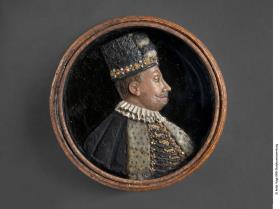
In einem Kapselrahmen wird das im Profil nach rechts ausgerichtete Brustbild des etwa dreißigjährigen König Sigismund III. Wasa aufbewahrt. Auf dem Kopf trägt er einen hohen, runden Hut, der reich mit Edelsteinen, Perlen und einer Feder geschmückt ist. Darunter schaut sein kurz geschnittenes blondes Haar hervor. Der König lässt sich gut an seinem Schnurrbart erkennen, allerdings ist der für ihn charakteristische Spitzbart inzwischen verlorengegangen. Von erlesener Eleganz zeugt die kostbare Tracht. Unter dem offenen und am Saum hermelinbesetzten Mantel erscheint ein reich geschnürtes Wams, dessen Knöpfe und Kordeln aus Kupferdrähten gebildet sind. Um den Hals trägt er eine gefältelte weiße Halskrause.Sigismund III. wurde am 20 Juni 1566 als Sohn von Johann III. Wasa von Schweden und Katharina Jagiellonika, Schwester des polnischen Königs Sigismund II. auf Schloss Gripsholm in Schweden geboren. Damit gehörte er gleichermaßen beiden Geschlechtern an. Zunächst folgte Sigismund III. 1587 Stephan I. Barthory (1522-1586) auf den polnischen Thron und als Sohn Johann Wasas wurde er 1592 schließlich auch König von Schweden. Als strenger Katholik, dem Papst stets ergeben, geriet der König aus dem Hause Wasa in zahlreiche – nicht immer erfolgreiche – kriegerische Auseinandersetzungen mit den polnischen Magnaten, aber auch mit Russen, Schweden und den Türken, die er 1621 in der Schlacht bei Chocim besiegte. Zugleich galt Sigismund III. als großer Förderer der Künste, indem er vor allem italienische Architekten an den polnischen Hof zog und eine besondere Wertschätzung für Gemälde und die Goldschmiedekunst entwickelte, in der er selbst erfolgreich dilettierte. Durch seine engen Verbindungen zum kaiserlichen Hof in Wien und Prag, wo die Medaillen- und Wachsporträtkunst großes Ansehen genoss, dürfte auch König Sigismund III. an diesen Preziosen Gefallen gefunden haben und die Bildnisse von sich und seiner ersten Frau Anna II. aus dem Hause Habsburg (sieheInv. Nr. 822) bei den bedeutenden Wachsmodellierer Antonio Abondio und seiner Werkstatt in Auftrag gegeben haben.Von dem Bildnismedaillon Sigismunds III. wie auch das seiner ersten Frau Anna II. existieren Repliken auf Schloss Gripsholm (Schweden).

Kreuzigung Christi / The Crucifixion

Kreuzigung Christi / The Crucifixion

Inscription on the bottom of the frame: AVE MARIA GRATIE PLENA DOMINUS TEC[UM]; at the base of the frame are two coats of arms: of the Barbarori family on the right side; the one on the left hand side is unidentified.ProvenanceSanta Maria in Monteluce, Perugia (before 1903); Berlin, Skulpturensammlung/Kaiser-Friedrich-Museum (1904-1939); Berlin, storage (1939-1945); Soviet Union, secret storage (1945/46-1958); East Berlin, Skulpturensammlung/Bode-Museum (1958-1990); Berlin, Skulpturensammlung/Bode-Museum (1990-present).AcquisitionBought in 1903 (through the gift of James Simon) as by a Florentine Master, ca. 1450, together with a David by Antonio di Banco (Inv. SKS 2794), for 8,540 Mark. Acquisition file n°I. 3789/03 (Zentralarchiv der Staatlichen Museen zu Berlin).Restorationca. 2000.ExhibitionSchätze der Weltkultur von der Sowjetunion gerettet, East Berlin, National-Galerie and Pergamonmuseum, 1958, cat. D 76.Curatorial files in the Bode-Museum• Correspondence between Luciano Bellosi and Michael Knuth (1997-2007); see comment.• Michael Knuth (April 1996) attribution to Dello Delli (on the basis of a Crucifixion from Careggi published in B. Borngässer, “Die Apsisdekoration der alten Kathedrale zu Salamanca”, Mitteilungen des Kunsthistorisches Institutes in Florenz, XXXI, 1987, p. 273 fig. 30).CommentThis work is a pathetic yet beautiful vision of the moment of the Crucifixion of Jesus Christ: aspects of pure drama (such as the fainting Virgin Mary on the left foreground, surrounded by the Magdalene, St John and another Mary; or the suffering of the bad thief on the right-hand cross) are presented next to careful anatomical studies (such as Christ or the Roman soldier in the right foreground). The main interest of this work lies in the eclectic capacity of its author to switch from the “high” culture of the Renaissance, with foreshortening based on perspectival and anatomical studies (the two thieves and their crosses), to “low” culture related to popular devotion, sometimes at the limits of caricature (the standing Roman soldiers at the feet of the Cross).The plinth of the relief’s frame bears the inscription “Ave Maria Gratia Plena, Dominus Tecum”, which has led to the assumption that it did not originally belong with the relief, as the salutation to the Virgin is better suited to an Annunciation or a Virgin and Child (see Schottmüller 1913 and 1933); however the frame appears to be original to the relief. The armorial shield at the bottom-right of the frame is that of the Barbadori family; the one on the left is unidentified, even though it is close to that of the Florentine Ricasoli family – it is possibly the shield of a family from Perugia, where the relief comes from (it is said to come from the church of Santa Maria in Monteluce in Perugia, which was rebuilt during the 16th century). Schottmüller 1913 saw affinities with the works of Sienese sculptors of the second half of the 15th century: Neroccio de’ Landi, Vecchietta, Francesco di Giorgio Martini and Giacomo Cozzarelli. The latter artist was suggested as the author of the work by Bode 1916, followed by Bange 1933 and Schottmüller 1933, while Meller 1963 thought of the eccentric Florentine artist who went to Spain, Dello Delli. Another Florentine artist who went to Spain has been the most cited author of the relief: Giuliano di Nofri, also called Giuliano Fiorentino. This proposition of Schubring 1919 (see also Schubring 1921) was recently reassessed by Franci 2001 and has been endorsed by Gentilini 2007: the affinities of the Berlin relief with the marble decoration of the Cathedral of Valencia, especially the reliefs of the Crucifixion and Samson Breaking the Doors of Gaza, are indeed quite compelling. Giancarlo Gentilini (oral communication, May 2014) made an interesting confrontation with another Crucifixion in the Szépmüvészeti Múzeum in Budapest, which may be by the same artist (cartapesta with gilt background, 70 x 42 cm, Inv. 51.929; see Mária G. Aggházy, Italian and Spanish Sculpture, Budapest, Kossuth Printing House, 1977, cat. 15).Before attributing the relief to Giuliano Fiorentino, Schubring had stated that that it reminded him of Donatello’s style, especially as seen in the bronze pulpits of San Lorenzo – one of the master’s last works. This relationship to Donatello, which must have been more compelling when the relief was covered with a bronze patina (removed in a restoration during the 2000s), had almost convinced one of the greatest specialists on Donatello, Luciano Bellosi, to attribute the work to the artist. Between 1997 and 2007, Bellosi repeatedly wrote to Michael Knuth, curator of the Berlin Skulpturensammlung, to share his opinion; a passage from one of Bellosi’s articles dedicated to the early activity of Donatello for the Florentine Cathedral also argues in favor of this attribution; Bellosi never published the text (see the article in Margaret Haines (ed.), Santa Maria del Fiore. The Cathedral and its Sculpture, Fiesole, Cadmo, 2001), which is preserved in the archive of the Bode-Museum.LiteratureSchubring 1907Paul Schubring, “Gli acquisti del museo ‘Kaiser Friedrich’”, L’Arte, X, 1907, p. 451: recalls Donatello, especially the pulpits of San Lorenzo in Florence.Schottmüller 1913Frida Schottmüller, Die italienischen und spanischen Bildwerke der Renaissance und des Barocks in Marmor, Ton, Holz und Stuck, Berlin, Georg Reimer, 1913, pp. 104-105 cat. 257: Sienese, ca. 1450-70; the inscription means that the frame is probably not original; mixture of Sienese (Jacopo della Quercia) and Donatellesque elements; close to Vecchietta; the figures around the fainting Virgin recall the group in the Osservanza, Siena; maybe a Sienese artist active in Umbria and in the Marche, not necessarily Francesco di Giorgio Martini or Giacomo Cozzarelli.Bode 1916Wilhelm von Bode, “Die Sammlung der Sienesischen Bildwerke des Quattrocento im Kaiser-Friedrich-Museum”, Amtliche Berichte aus der Königl. Kunstsammlungen, XXXVII, n°9, June 1916, col. 176-79: Giacomo Cozzarelli?Scgubring 1919Paul Schubring, Die italienische Plastik des Quattrocento, Berlin, Akademische Verlagsgesellschaft Athenaion, 1919, pp. 26, 193: Giuliano Fiorentino, before 1450.Bode 1921Wilhelm von Bode, Bollettino d’arte, 2nd series, I, 1921, p. 347. (reference to be checked)Mayer 1922-23August L. Mayer, “Giuliano Fiorentino”, Bollettino d’arte, II, 1922-23, p. 337 or 341: not Giuliano Fiorentino? (reference to be checked)Bange 1933E. F. Bange, Italienische Skulpturen im Kaiser Friedrich Museum, Berlin, Staatliche Museen in Berlin, 1933, pl. 47: Giacomo Cozzarelli?Schottmüller 1933Frida Schottmüller, Die italienischen und spanischen Bildwerke der Renaissance und des Barock. Erster Band. Die Bildwerke in Stein, Holz, Ton und Wachs, Zweite Auflage, Berlin and Leipzig, Walter de Gruyter & Co., 1933, p. 94: Giacomo Cozzarelli? The base with the inscription comes from a tabernacle of the Virgin and Child or an Annunciation. Derives from Jacopo della Quercia and Vecchietta.Middeldorf 1938Ulrich Middeldorf, review of Schottmüller 1933, Rivista d’arte, XX, 1938 now in: idem, Raccolta di scritti that is Collected Writings. I. 1924-1938, Florence, SPES, 1979-80, p. 382: better and earlier than Cozzarelli. Magnificent.Schätze der Weltkultur… 1958Schätze der Weltkultur von der Sowjetunion gerettet, exh. cat. (East Berlin, National-Galerie and Pergamonmuseum, 1958), East Berlin, Staatliche Museen zu Berlin, 1958, cat. D 76: Giacomo Cozzarelli?Franci 2001Andrea Franci, “Giuliano di Nofri scultore fiorentino”, Mitteilungen des Kunsthistorischen Institutes in Florenz, XLV, n°3, 2001, pp. 439-440, 457 notes 30-31: Giuliano di Nofri, ca. 1430; compared to a Crucifixion and a Samson breaking the doors of Gaza in the Cathedral of Valencia; an 1872 guide by Guardabassi mentions a wooden Crucifixion in the church of Santa Maria in Monteluce.Bellandi 2005A. Bellandi in Botticelli, Via Maggio, Florence, 2005, n. p. (reference to be checked)Franci 2007Andrea Franci, “Giuliano di Nofri”, in Saur Allgemeines Künstlerlexikon, Munich and Leipzig, Saur, 55, 2007, p. 425: Giuliano di Nofri, said to be formerly in Berlin (sic).Gentilini 2007Giancarlo Gentilini, Donatello e Nanni di Bartolo. Una inedita Madonna in terracotta, Milan, Cesati e Cesati, 2007, p. 37 note 17: accepts the attribution to Giuliano di Nofri of this work and of the tabernacle of the Virgin and Child in the Museo Civico, Prato, but not the rest of the reconstruction in Franci 2001.Neville Rowley (24 May 2016)

Wandkonsole mit reichem Blattbesatz

Wandkonsole mit reichem Blattbesatz

Die Konsole hat eine kelchförmige Gestalt mit Blattornamenten und rechteckiger Deckplatte. Die Deckplatte zeigt ein halbiertes Sechseck und ist wohl dadurch zu erklären, dass sie im schrägen Gewände des Portals gestanden haben wird. Der vegetabile Schmuck besteht aus einer Reihe von Blättern, die dem Kelch aufgelegt sind und zur eckigen Form der Deckplatte vermitteln. Dadurch wird die tektonische Strenge überspielt, ohne gegen die Konventionen des Aufbaus einer gotischen Konsole zu verstoßen.Die Kirche des in den 1030er-Jahren am linken Aaufer gegründeten Damenstifts Liebfrauen war von Beginn an zugleich Pfarrkirche der Bürger der Münsteraner Vorstadt Überwasser. Diese Doppelfunktion, die sich auch in der Finanzierung und Nutzung des 1340 begonnenen Neubaus spiegelt, dürfte für die Konzeption des Westportals von Bedeutung gewesen sein. Mit der Errichtung des Turms wurde, wie man aus einem Bauvertrag weiß, 1363/64 begonnen. 1374 ließ Fürstbischof Florenz von Wevelinghoven (amt. 1364–78) mehrere Reliquien in der rechten Schulter des Marienbildes am Portal einschließen und man hat zu Recht angenommen, dass zu diesem Zeitpunkt das Portal mit seinem Figurenschmuck vollendet war, vielleicht auch schon bereits seit mehreren Jahren. Die Funktion der Konsolen ist die Vermittlung zwischen der streng geometrischen Architektursprache des kunstvollen Portalgebildes und der menschlichen Figur. Daher wurden auch die einzelnen Glieder (Halsring und Kelch) in fantasievolle pflanzliche Gebilde aufgelöst, deren wohl kalkulierter Verismus nicht auf effektvolle Überraschung abzielt, sondern der Wirkungs- und Bedeutungseinheit von Architektur und Skulptur dient.Die Konsolen des Westportals der Liebfrauenkirche passen gut in die Genese gotischer Laubwerkgestaltung, bei der um 1350 eine Tendenz zur stärkeren Bewegung und einem Verwischen der Grenzen zwischen Wand und Ornament festzustellen ist. Die Werkstatt hat, wie die geringere Qualität der späteren Konsolen in Münster zeigt, die Stadt wieder verlassen, möglicherweise, um in Utrecht zu arbeiten, wo sich am Dom um 1380 vergleichbare figürliche Darstellungen finden. Der Steinmetz hat sich eindeutig an der Bauornamentik des Kölner Doms orientiert, wie eine Durchsicht der dortigen Kapitelle im Chor und Langhaus zeigt. (Auszug aus: Tobias Kunz, Bildwerke nördlich der Alpen. 1050 bis 1380. Kritischer Bestandskatalog der Berliner Skulpturensammlung, Petersberg, Michael Imhof Verlag 2014)

Kopffragment auf Büstenkopie: Bildnis einer Prinzessin von Neapel

Kopffragment auf Büstenkopie: Bildnis einer Prinzessin von Neapel

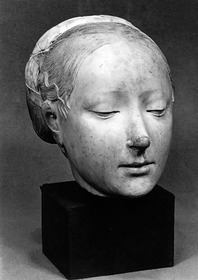
Francesco Laurana war einer der vielseitigsten Bildhauer der Renaissance und arbeitete für bedeutende Fürsten in Italien und Frankreich. Seine weiblichen Büsten sind für die damalige Zeit bemerkenswert, weil sie ihrem Modell einen überraschend modernen Abstraktionsgrad verleihen. Diese Büste stellt wahrscheinlich eine reich gekleidete Prinzessin des Königreichs Neapel dar, deren Brust einst mit einem Edelstein geschmückt war. Die Büste, die am Ende des Zweiten Weltkriegs durch Brände schwer beschädigt wurde, hatte ein einzigartiges Schicksal: Während der Kopf immer in Berlin geblieben ist, gelangte der untere Teil in die Sowjetunion und befindet sich heute im Puschkin-Museum in Moskau. Letzterer wird hier durch einen Abguss ersetzt.Francesco Laurana was one of the most eclectic sculptors of the Renaissance, working for important princes of Italy and France. His female busts are remarkable for the time because they give their model a surprisingly modern degree of abstraction. The present bust probably represents a princess of the Kingdom of Naples, richly dressed and whose chest was once adorned with a precious stone. The bust, which was badly damaged by fire at the end of the Second World War, had a singular fate: while the head has always remained in Berlin, the lower part was transferred to the Soviet Union and is now kept in the Pushkin Museum in Moscow. This lower part is replaced here by a plaster cast.

Maria mit dem Kind im Mantel

Maria mit dem Kind im Mantel

Zusammen mit den mandelförmigen Augen der Jungfrau zeigen die überlängten Proportionen der Figuren, dass das Werk in einer Zeit geschaffen wurde, als der junge Donatello noch von der Gotik beeinflusst war. Die Originalität des Künstlers ist jedoch bereits in der dynamischen Haltung des Kindes sichtbar, und in der Art, wie das Relief viel tiefer erscheint als es tatsächlich ist.Erworben 1892Together with the almond-shaped eyes of the Virgin, the elongated proportions of the figures indicate that the work was created at a time when the young Donatello was still under the influence of Gothic taste. Yet the originality of the artist is already visible in the dynamic pose of the Child, and in the way the relief appears much deeper than it actually is.--Attributed to DonatelloVirgin and Childca. 1410-15Terracotta, formerly painted90 x 67.5 cmBerlin, Staatliche Museen, Skulpturensammlung, Inv. SKS 1940.Bode-Museum, on view.ProvenanceFlorence (1892); Berlin, Skulpturensammlung/Altes Museum (1892-1904); Berlin, Skulpturensammlung/Kaiser-Friedrich-Museum (1904-1939); Berlin, storage (1939-1945); Soviet Union, secret storage (1945/46-1958); East Berlin, Skulpturensammlung/Bode-Museum (1958-1990); Berlin, Skulpturensammlung/Bode-Museum (1990-present).AcquisitionAcquired in Florence in 1892, gift of Oscar Huldschinsky.Restorations1958; 1977-78; 2009.ExhibitionsSchätze der Weltkultur von der Sowjetunion gerettet, East Berlin, National-Galerie and Pergamonmuseum, 1958, cat. D 47.Versions• Bologna, Palazzo Grassi (formerly Tribunale Militare).• Formerly Bologna, Caprara Orléans collection.CommentThis Virgin and Child is a masterpiece of Florentine sculpture from the beginnings of the 15th century – when terracotta was once again used in Italy after a long period of disinterest. The Virgin and the Child are not looking at each other, but at the beholder; however, they are closely linked: the standing Child (supported by the Virgin’s left hand) has flung his right arm around his mother’s neck, while his left arm is covered by her veil (this veil has often been seen as a mantle, hence the name of the composition proposed by Knuth 1990 and Jolly 1998). Tschudi 1892 notes ancient traces of color on the relief; in any case, the paint on the Virgin’s eyes visible in pre-WWII photographs is a modern addition. The current absence of color allows the modeling to be fully appreciated. The fringes of the folds are especially well rendered, as is the drapery in general, through which the anatomy of the figures remains visible – an aspect that was not frequent in early 15th-century Florence. The Virgin’s hair and hands, or the Child’s legs seems to indicate that the work was modeled and not cast from a mold (the deep hollows in the Virgin’s hair also support this judgement).The relief allegedly comes from a villa near Florence, where it was acquired by the Berlin Museums through the Florentine dealer Stefano Bardini with funds provided by Oskar Huldschinski (Bode 1899; the work is sometimes called the Huldschinski Madonna even if it was never part of the rich collection of the entrepreneur). This provenance may explain why the attribution of the work mostly focused on Tuscan artists, while another version of the Madonna, located in the Palazzo Grassi, Bologna, had made Bode 1891 think of Niccolò dell’Arca (see also Malaguzzi Valeri 1932-33, who published the third known version, then also in Bologna, and attributed it to the school of Niccolò dell’Arca). Bode 1899 first proposed that the work was by one of the many Tuscan masters active in Central and Southern Italy. Schottmüller 1913 grouped the work with the Crowning of the Virgin from Santa Maria Novella in Florence now attributed to Dello Delli. In a groundbreaking article, Bode 1914 grouped several Virgin and Child versions in terracotta, including this one, under thename of Lorenzo Ghiberti. Even if this attribution was generally followed, Schottmüller 1932-1933 preferred to see a work by Donatello. This dispute lasted for some decades; during the Cold War, as the sculpture was in the Bode-Museum in East Berlin, the publications of the East insisted more on Donatello, while (consciously or not) the West preferred to point towards Ghiberti.The influence of Ghiberti is indeed visible in the drapery, the elongated proportions and the almond-shaped eyes of the Virgin. However, the Donatellesque traits are much more pronounced: the dynamism of the Child’s pose and his play with his mother’s veil; the fringes of the mantle recurrent in many early works in Florence (from the marble David in the Museo Nazionale del Bargello to the St Peter carved for Orsanmichele); the foreshortening of the Virgin’s right arm, which appears almost superimposable with the arm of the cited David and of the St John the Evangelist made for the Cathedral of Florence and now in the Museo dell’Opera del Duomo (Middeldorf 1938 interestingly rejected the Donatello attribution, but paired the sculpture with the Virgin and Child in the church of San Martino, Pontorme, now widely ascribed to the young Donatello). As the David and the St John by Donatello are documented between 1408 and 1416, this Madonna should be dated to ca. 1410-15. The references to the art of Ghiberti are all the more understandable if the work is by Donatello, as the latter was a pupil of Ghiberti between 1403 and 1407.The Berlin Madonna was badly damaged by fire at the end of WWII. Transferred to the Soviet Union in 1946, the work was returned to East Berlin in 1958 (Grohn 1959). The sculture was restored beforehand; a photograph of the damaged state of the sculpture reveals which parts are original (see Schade 1985; and Kunth 1990). Such damage makes it difficult to ascertain if the work is an original creation by Donatello, rather than a replica. This uncertainty is compounded by the other version in Palazzo Grassi, Bologna, which seems very similar to the Berlin relief but is difficult to access (the version once in the Palazzo Caprara Orléans, now badly damaged, appears to be of much lower quality).LiteratureTschudi 1892Ugo von Tschudi, “Bildwerke der Christlichen Epoche”, Jahrbuch der Königlich Preußischen Kunstsammlungen, XIII, 1892, p. LXXII: Florentine, ca. 1425; style of Jacopo della Quercia. Traces of ancient color.Bode 1899Wilhelm Bode, “Le opere di Niccolò dell’Arca”, L’Arte, II, 1899, p. 499: Tuscan master, active in Central and Southern Italy; found in a villa in the outskirts of Florence; related to another version of the work in the Military Tribunal, Bologna, once published by the author as by Niccolò dell’Arca (Wilhelm Bode, Die italienische Plastik, Berlin, W. Spemann, 1891, pp. 126-127) but not discussed in the following editions of the same book.Schottmüller 1913Frida Schottmüller, Die italienischen und spanischen Bildwerke der Renaissance und des Barocks in Marmor, Ton, Holz und Stuck, Berlin, Georg Reimer, 1913, p. 6 cat. 7: Florentine, ca. 1425; perhaps circle of Bicci di Lorenzo, the author of the Coronation of the Virgin on the façade of Santa Maria Nuova, Florence.Bode 1914Wilhelm von Bode, “Lorenzo Ghiberti als Führender Meister unter den Florentiner Tonbildern der ersten Hälfte des Quattrocento”, Jahrbuch der königlich preußischen Kunstsammlungen, XXXV, 1914, pp. 81-82: Lorenzo Ghiberti.Bode 1921Wilhelm Bode, Florentiner Bildhauer der Renaissance, Berlin, Bruno Cassirer, 1921, p. 84 fig. 41: Ghiberti.Wulff 1922Oskar Wulff, “Ghibertis Entwicklung im Madonnenrelief”, Berliner Museen, XLIII, 9-10, September-October 1922, p. 100: Ghiberti.Malaguzzi Valeri 1932-33Francesco Malaguzzi Valeri, “Sculture del Rinascimento a Bologna”, Dedalo, III, 1932-33, pp. 356, 360: publishes the version in the Caprara Orléans collection, attributed to the school of Niccolò dell’Arca.Schottmüller 1932-33Frida Schottmüller, “Ein Jugendwerk Donatellos im Kaiser-Friedrich-Museum”, Zeitschrift für Kunstgeschichte, I, 1932-1933, pp. 336-340: Donatello.Bange 1933E. F. Bange, Italienische Skulpturen im Kaiser Friedrich Museum, Berlin, Staatliche Museen in Berlin, 1933, pl. 19: Florentine Master ca. 1525 (sic).Schottmüller 1933Frida Schottmüller, Die italienischen und spanischen Bildwerke der Renaissance und des Barock. Erster Band. Die Bildwerke in Stein, Holz, Ton und Wachs, Zweite Auflage, Berlin and Leipzig, Walter de Gruyter & Co., 1933, pp. 6-7: Donatello; cites an unpublished Virgin and Child in the Victoria and Albert Museum, London (Inv. 62-03), by the same hand as the Coronation of the Virgin in the façade of Santa Maria Nuova, Florence; but said to be by a different artist.Bange 1934E. F. Bange, Die Italienischen Bildwerke im Kaiser-Friedrich-Museum, Berlin, Verlag für Kunstwissenschaft, 1934, pp. 21-22: Donatello?Middeldorf 1938Ulrich Middeldorf, review of Schottmüller 1933, Rivista d’arte, XX, 1938, pp. 97-98 now in: idem, Raccolta di scritti that is Collected Writings. I. 1924-1938, Florence, SPES, 1979-80, p. 378: anonymous, same hand as the Virgin and Child in San Martino, Pontorme; the Singing Angels divided between the Kaiser-Friedrich-Museum, Berlin (Inv. SKS 1902) and the Musée du Louvre, Paris (Inv. RF 690); and the Virgin and Child in the Victoria and Albert Museum, London (Inv. 8378-1863).Valentiner 1940W. R. Valentiner, “Donatello and Ghiberti”, The Art Quarterly, III, 1940, pp. 210-213 now in: idem, Studies of Italian Renaissance Sculpture, London, Phaidon Press, 1950, pp. 63, 65: Lorenzo Ghiberti; compared to a Virgin and Child in the Detroit Institute of Arts (Inv. 40.19), also given to Ghiberti.Gnudi 1942Cesare Gnudi, Niccolò dell’Arca, Turin, Einaudi, 1942, p. 82: Tuscan.“Verzeichnis…” 1953“Verzeichnis der im Flakturm Friedrichshain verlorengangenen Bildwerke der Skulpturen-Abteilung”, Berliner Museen, new series, III, n°1-2, 1953, p. 11: burnt between 5 and 10 May 1945.Schätze der Weltkultur… 1958Schätze der Weltkultur von der Sowjetunion gerettet, exh. cat. (East Berlin, National-Galerie and Pergamonmuseum, 1958), East Berlin, Staatliche Museen zu Berlin, 1958, cat. D 47: Donatello.Feist 1959P. H. Feist, Florentinische Frührenaissance-Plastik in den Staatliche Museen zu Berlin, Leipzig, Seemann, 1959, p. 15: Donatello, ca. 1425.Grohn 1959Hans Werner Grohn, “Report on the Return of Works of Art from the Soviet Union to Germany”, The Burlington Magazine, CI, n°670, January 1959, p. 58 fig. 18-19, p. 61: the work, destroyed and in pieces in Berlin in 1945, was “completely assembled in the workshops of the Hermitage”. “It must be stressed that in no case were there any additions made in the process of restoration, but permanent losses of material were substituted by some neutral ingredient.”Malerei und Plastik… 1960Malerei und Plastik. Meisterwerke aus acht Jahrhunderten, East Berlin, Henschelverlag Kunst und Gesellschaft, 1960, pp. 104-105: Donatello?Fründt 1963Edith Fründt, Italienische Plastik des 15.-17. Jahrhunderts, East Berlin, Staatliche Museen zu Berlin, 1963, p. 12 cat. 3: Donatello?Pope-Hennessy 1964John Pope-Hennessy, Catalogue of Italian Sculpture in the Victoria and Albert Museum, London, Her Majesty’s Sationery Office, 1964, I, p. 372: follows Middeldorf 1938.Schulz 1966Sabine Schulz, Staaltiche Museen zu Berlin. Gesamtführer, East Berlin, Staatliche Museen zu Berlin, 1966, pp. 82, 162 (fig.): Florentine, ca. 1420; attributed to Donatello.Wundram 1969Manfred Wundram, Donatello und Nanni di Banco, West Berlin, De Gruyter, 1969, pp. 24, 60.Knuth 1982Michael Knuth, Skulpturen der italienischen Frührenaissance, East Berlin, Staatliche Museen zu Berlin, 1982, pp. 5-8: Donatello, ca. 1415.Rosenauer 1982Artur Rosenauer, “Zum Geremia vom Florentiner Campanile”, Münchner Jachbuch der bildenden Kunst, 3rd series, XXXIII, 1982, p. 70.Darr 1985Alan Phipps Darr in Italian Renaissance Sculpture in the Time of Donatello, exh. cat. (Detroit, The Detroit Institute of Arts, 23 October 1985-5 January 1986 and Fort Worth, Kimbell Museum of Art, 22 February-5 April 1986), Detroit, The Detroit Institute of Arts, 1985, p. 107: attributed to Donatello.Effenberger 1985Arne Effenberger, Führer durch das Bodemuseum, East Berlin, Staatliche Museen zu Berlin, 1985, p. 74: Donatello, ca. 1415.Schade 1985Günter Schade, “Zur Geschichte der Berliner Museumsinsel von Mai 1945 bis Oktober 1959”, in idem (ed.), Weltschätze der Kunst – der Menschheit bewahrt, exh. cat. (East Berlin, Altes Museum, 13 March-23 May 1985), East Berlin, Staatliche Museen zu Berlin, 1985, pp. 26-29: photograph of the work in pieces in the Soviet Union, and copy of the restoration file of 1958.Darr 1986Alan Phipps Darr in idem and Giorgio Bonsanti (eds.), Donatello e i suoi, exh. cat. (Florence, Forte del Belvedere, 15 June-7 September 1986), Detroit and Florence, The Detroit Institute of Arts, La Casa Usher and Arnaldo Mondadori Editore, 1986, p. 132: attributed to Donatello.Fründt 1987Edith Fründt, “Skulpturensammlung”, in Die Museumsinsel zu Berlin, East Berlin, Henschelverlag Kunst und Gesellschaft, 1987, p. 183 fig. 329: Donatello, ca. 1415.Filieri 1988Maria Teresa Filieri, “Edicole sacre nel XV secolo” in eadem (ed.), Immagini di devozione a Lucca, exh. cat. (Lucca, Complesso monumentale di San Micheletto, 18 September-20 October 1988), Lucca, Rugani officine grafiche lucchesi, 1988, p. 12: close to two groups of the Virgin and Child works recently rediscovered in Lucca, but also to a Virgin and Child once in the Vellutini collection, Florence.Kecks 1988Ronald G. Kecks, Madonna und Kind. Das häusliche Andachtsbild im Florenz des 15. Jahrhunderts, West Berlin, Gebr. Mann Verlag, 1988, pp. 56, 88 pl. XXVII fig. 57: circle of Ghiberti, ca. 1440.Forlani Tempesti 1989Anna Forlani Tempesti, “Restauri donatelliani dell’Opificio delle Pietre Dure”, in Donatello-Studien, Munich, Bruckmann, 1989, p. 101 note 9: attributed to Donatello.Gentilini 1989Giancarlo Gentilini in idem and Carlo Sisi (eds.), La scultura. Bozzetti in terracotta, piccoli marmi e altre sculture dal XIV al XX secolo, 1, Siena, Palazzo Chigi Saracini, 1989, p. 45 (Monte dei Paschi di Siena. Collezione Chigi Saracini 4): Donatello.Knuth 1990Michael Knuth, “Die Berliner ‘Maria mit dem Kind im Mantel’ – ein Frühwerk Donatellos?”, Forschungen und Berichte, 28, 1990, pp. 201-210: Donatello, ca. 1415.European Works of Art and Sculpture 1990European Works of Art and Sculpture, sale catalogue (London, Sotheby’s, 13 December 1990), p. 24: compared to a Virgin and Child in terracotta attributed to the circle of Donatello now in the Kimbell Museum of Art, Fort Worth.Gentilini 1992Giancarlo Gentilini, I della Robbia. La scultura invetriata nel Rinascimento, Florence, Cantini, 1992, I, p. 158 note 14: attributed to Donatello.Bellosi and Gentilini 1996Luciano Bellosi and Giancarlo Gentilini, “Una nuova Madonna in terracotta del giovane Donatello”, Pantheon, LIV, 1996, pp. 19-26 (now in: Una nuova Madonna in terracotta del giovane Donatello, exh. cat. Turin, Antichi maestri pittori, 4 April-30 Mai 1998¬¬, Turin, Antichi maestri pittori, pp. 20-21, 23, 33): Donatello.Castelnuovo 1998Enrico Castelnuovo, “Inedito e delicato Donatello”, Il Sole 24 Ore, 87, Sunday 29 March 1998, p. 23: Donatello, related to the Madonna published by Bellosi and Gentilini 1996.Jolly 1998Anna Jolly, Madonnas by Donatello and his Circle, Frankfurt am Main et al., Peter Lang, 1998, pp. 99-100 cat. 14.1: Donatello; late decade after 1400 or early 1410s; called the “Madonna with the cloak”.Cavazzini 2002Laura Cavazzini in Luciano Bellosi, Laura Cavazzini and Aldo Galli (eds.), Masaccio e le origini del Rinascimento, exh. cat. (San Giovanni Valdarno, Casa Masaccio, 20 September-21 December 2002), Geneva and Milan, Skira, 2002, p. 116: Donatello.Darr 2002Alan P. Darr in idem, Peter Barnet and Antonia Boström, Catalogue of Italian Sculpture in the Detroit Institute of Arts, Volume One. Eighth to Sixteenth Century, London and Turnhout, Harvey Miller Publishers and Detroit Institute of Arts, 2002, p. 91: attributed to Donatello; related to a Virgin and Child in the Detroit Institute of Arts (Inv. 40.19).Galli 2002Aldo Galli in Luciano Bellosi, Laura Cavazzini and Aldo Galli (eds.), Masaccio e le origini del Rinascimento, exh. cat. (San Giovanni Valdarno, Casa Masaccio, 20 September-21 December 2002), Geneva and Milan, Skira, 2002, p. 118: Donatello.Galli 2003Aldo Galli, “Calchi in stucco del primo Rinascimento: quattro ‘Madonne’ della Fondazione Giorgio Cini”, Saggi e memorie di storia dell’arte, 27, 2003, p. 161: Donatello.Casciaro 2005Raffaele Casciaro, “Variazione su tema ghibertiano: una ‘Madonna’ in terracotta del primo Quattrocento fiorentino”, Rassegna di studi e di notizie, vol. XXIX, anno XXXII, 2005, p. 87 fig. 18: Donatello.Grisko 2006 ed. 2007Michael Grisko, “Die Ausstellung: Einblicke in die vier Sammlungen”, in Carola Wedel (ed.), Das Bode-Museum. Schatzkammer der Könige, Berlin, Jaron Verlag, 2006 (2nd ed. 2007), p. 102 (Donatello); p. 110 (Benedetto da Maiano; sic).Knuth 2006Michaël Knuth in Skulpturensammlung im Bode-Museum, Munich et al., Prestel, 2006, pp. 125-126: Donatello.Rowley 2013Neville Rowley, Donatello. La renaissance de la sculpture, Garches, A Propos, 2013, pp. 10-11: attributed to Donatello.Gregory D’Apuzzo 2014Mark Gregory D’Apuzzo, “Francesco Malaguzzi Valeri e la scultura del Rinascimento a Bologna: precisazioni e il ‘caso’ della donatelliana ‘Madonna’ Grassi”, in Alessandro Rovetta and Gianni Carlo Sciolla (eds.), Francesco Malaguzzi Valeri (1867-1928). Tra storiografia artistica, museo e tutela, symposium papers (Milan, 19 October 2011 and Bologna, 20-21 October 2011), Milan, Scalpendi Editore, 2014, pp. 78-81: about the other versions.Curatorial Files (Berlin, Bode-Museum)Letter from Artur Rosenauer (21.8.1990): circle of Donatello?Letter from Francesco Caglioti (14.10.2005): Donatello.Neville Rowley (20 May 2016)