Maria mit dem Kind
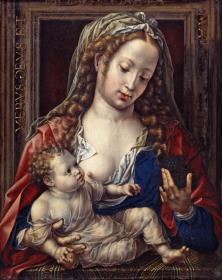
Die Madonnenbilder bezeichnen einen der Höhepunkte im Schaffen Gossaerts. Überblickt man die Entwicklung des traditionsreichen Bildthemas, das in der niederländischen Malerei von van Eyck über Memling, Sittow und Massys bis hin zu Gossaert führt, dann zeigt sich, in welchem Ausmaß man die künstlerische Überlieferung zu bewahren verstand, sie andererseits jedoch um neue Möglichkeiten zu bereichern wußte. Die Enge der Raumbühne, auf der die Bildfiguren kaum Platz finden, entspringt dem Anliegen, deren Körperlichkeit besonderen Nachdruck zu verleihen. Maria und das Kind werden von einem reich profilierten graubraunen Rahmen eingefaßt, den sie mehrfach überschneiden, und aus dem heraus sie uns fast greifbar entgegentreten. Die rotbraun getönte Rückplatte des Rahmens bildet den Hintergrund, vor dem sich das schöne Antlitz Marias kontrastreich abhebt. Die differenzierte Modellierung durch Licht und Schatten ist dabei ebenso zu bewundern wie die malerische Behandlung der Haare, der Hände oder des unruhig bewegten Faltenwurfs der Gewänder. Die Beherrschung illusionistischer Effekte erweist sich besonders deutlich an den leicht gewölbten, wie aus Metall geschnittenen Buchstaben in der Hohlkehle der gemalten Rahmung. Sie bilden von links nach rechts umlaufend die folgende Inschrift: »VERVS DEVS ET HOMO – CASTA MATER ET VIRGO« (Ein wahrer Gott und Mensch, eine reine Mutter und Jungfrau). Mit leicht geneigtem Kopf und gesenkten Augen blickt Maria auf das Kind herab, das vor ihr auf der mit einem Teppich bedeckten Brüstung ruht. Maria trägt einen roten Mantel und ein blaues Kleid, das über der rechten Brust geöffnet ist. Ein weißes Kopftuch bedeckt das lange rotblonde Haar, das über die Schultern herabfällt. In ihrer linken Hand hält sie eine Weintraube, nach der das Kind verlangend die Hand ausstreckt. Dieser Gebärde gilt der sinnende Blick der Gottesmutter, in dem sich das Wissen um das Schicksal ihres Sohnes ausdrückt. Das lebhafte Kind ist nur mit einem dünnen Hemdchen bekleidet, unter dem sich sein kräftiger Körper abzeichnet. In der rechten Hand hält es den Apfel. Es ist die Frucht, die einst den Sündenfall besiegelte und sich nun in ein Unterpfand der Erlösung verwandelt hat. In dem Symbol des Apfels verdichten sich die vielfältigen Anspielungen und sinnbildhaften Bezüge auf die Inkarnation und den Kreuzestod Christi und seine Bedeutung für die auf Erlösung harrende Welt. Die Vorstellung, daß der Apfel den Menschen einst das Verderben brachte, sie damit aber auch am Erlösungswerk teilhaben läßt, ist Ausdruck jener alten Idee, nach der sich alle Ereignisse in der Neuschöpfung der Welt durch Christus gleichsam spiegelbildlich wiederholen. Die Gegenüberstellung des alten und des neuen Adam, der mit Christus gleichgesetzt wurde, sowie der ersten und der zweiten Eva, in der man die Gottesmutter erkannte, weisen auf dieselbe Ideenverbindung hin. So wie man Maria stets als den Weinstock besungen hat, an dem die Traube reifte, die uns den Wein des eucharistischen Blutes spendete, so ist die Traube in ihrer Hand ein sichtbares Zeichen dafür, daß das in der Passion vergossene Blut Christi den Fluch tilgen wird, den Eva über die Menschheit brachte, als sie den Apfel vom Baum der Erkenntnis pflückte. All diese Gedankenverbindungen waren dem gläubigen Betrachter unmittelbar verständlich und gegenwärtig. Rainald Grosshans | 200 Meisterwerke der europäischen Malerei – Gemäldegalerie Berlin, 2019SIGNATUR / INSCHRIFT: VERVS DEVS ET HOMO CASTA MATER ET VIRGO_____________________________________________________Images of the Madonna represent one of the highpoints of Gossart’s artistic oeuvre. When we survey the development of this pictorial type, so rich in tradition, and extending in Netherlandish painting from van Eyck to Memling, Sittow, and Massys, and all the way to Gossart, it becomes evident the degree to which artistic conventions were preserved while at the same time being consistently enriched with new possibilities.The narrowness of this pictorial stage, which barely affords the figures any space at all, is intended to endow their physicality with special emphasis. The Virgin Mary and the Christ child are framed by a richly-profiled, greyish-brown frame which they overlap repeatedly, and from which they almost seem to emerge directly into the viewer’s physical space. The reddish-brown-toned back panel of the frame forms a background against which Mary’s lovely countenance is set off in strong contrast. The nuanced modelling of light and shadow is as admirable as the painterly handling of the hair and the hands and the restless, agitated drapery folds of the garments. Gossart’s mastery of illusionistic effects is especially evident in the slightly convex letters, seemingly fashioned from cut metal, which are set against the fillet of the painted frame. Circumferentially from left to right, they form the following inscription: “VERVS DEVS ET HOMO – CASTA MATER ET VIRGO” (A true God and man, a pure mother and virgin).Her head slightly bowed and with lowered eyes, Mary gazes downward at the child, who rests before her on a parapet that is covered by a carpet. Mary wears a red cloak and blue gown, the latter opened to reveal her right breast. Her long, reddish blonde hair, which falls across her shoulders, is covered by a white headscarf. In her left hand, she holds a bunch of red grapes, towards which the Christ child eagerly stretches out his hand. This gesture seems to elicit the pensive gaze of the Mother of God, who seems aware of her son’s impending fate. The lively child is clad only in a thin undershirt, which delineates his powerful body. He holds an apple in his right hand – the fruit that precipitated the Fall from Grace, transformed now into a prerequisite for redemption.Concentrated in the symbol of the apple are a multiplicity of allusions and emblematic references to the Incarnation and to Christ’s death by crucifixion and its significance for a world that awaits salvation. The notion that the same apple that spelled the downfall of humanity now participates in the work of redemption is an expression of the venerable idea according to which all of the events transpiring during Christ’s re-creation of the world are so to speak recapitulated in mirror-invertedform. The juxtaposition of the old and new Adam, who was equated with Christ, as well as of the first and second Eve, in whom the Mother of God was discerned, points towards the same conceptual complex. Just as Mary was consistently extolled as the grapevine where the grapes ripen that bestow on us the wine of the Eucharistic blood, the grapes she holds in her hand are a visible sign that the blood of Christ, which flows during the Passion, redeems the curse which Eve imposed on humankind when she plucked the apple from the Tree of Knowledge. All of these associated ideas would have been comprehensible and palpable to early believing beholders of this image. Rainald Grosshans | 200 Masterpieces of European Painting – Gemäldegalerie Berlin, 2019