Maria mit dem Kind im Mantel
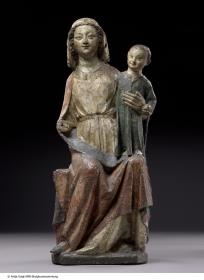
Zusammen mit den mandelförmigen Augen der Jungfrau zeigen die überlängten Proportionen der Figuren, dass das Werk in einer Zeit geschaffen wurde, als der junge Donatello noch von der Gotik beeinflusst war. Die Originalität des Künstlers ist jedoch bereits in der dynamischen Haltung des Kindes sichtbar, und in der Art, wie das Relief viel tiefer erscheint als es tatsächlich ist.Erworben 1892Together with the almond-shaped eyes of the Virgin, the elongated proportions of the figures indicate that the work was created at a time when the young Donatello was still under the influence of Gothic taste. Yet the originality of the artist is already visible in the dynamic pose of the Child, and in the way the relief appears much deeper than it actually is.--Attributed to DonatelloVirgin and Childca. 1410-15Terracotta, formerly painted90 x 67.5 cmBerlin, Staatliche Museen, Skulpturensammlung, Inv. SKS 1940.Bode-Museum, on view.ProvenanceFlorence (1892); Berlin, Skulpturensammlung/Altes Museum (1892-1904); Berlin, Skulpturensammlung/Kaiser-Friedrich-Museum (1904-1939); Berlin, storage (1939-1945); Soviet Union, secret storage (1945/46-1958); East Berlin, Skulpturensammlung/Bode-Museum (1958-1990); Berlin, Skulpturensammlung/Bode-Museum (1990-present).AcquisitionAcquired in Florence in 1892, gift of Oscar Huldschinsky.Restorations1958; 1977-78; 2009.ExhibitionsSchätze der Weltkultur von der Sowjetunion gerettet, East Berlin, National-Galerie and Pergamonmuseum, 1958, cat. D 47.Versions• Bologna, Palazzo Grassi (formerly Tribunale Militare).• Formerly Bologna, Caprara Orléans collection.CommentThis Virgin and Child is a masterpiece of Florentine sculpture from the beginnings of the 15th century – when terracotta was once again used in Italy after a long period of disinterest. The Virgin and the Child are not looking at each other, but at the beholder; however, they are closely linked: the standing Child (supported by the Virgin’s left hand) has flung his right arm around his mother’s neck, while his left arm is covered by her veil (this veil has often been seen as a mantle, hence the name of the composition proposed by Knuth 1990 and Jolly 1998). Tschudi 1892 notes ancient traces of color on the relief; in any case, the paint on the Virgin’s eyes visible in pre-WWII photographs is a modern addition. The current absence of color allows the modeling to be fully appreciated. The fringes of the folds are especially well rendered, as is the drapery in general, through which the anatomy of the figures remains visible – an aspect that was not frequent in early 15th-century Florence. The Virgin’s hair and hands, or the Child’s legs seems to indicate that the work was modeled and not cast from a mold (the deep hollows in the Virgin’s hair also support this judgement).The relief allegedly comes from a villa near Florence, where it was acquired by the Berlin Museums through the Florentine dealer Stefano Bardini with funds provided by Oskar Huldschinski (Bode 1899; the work is sometimes called the Huldschinski Madonna even if it was never part of the rich collection of the entrepreneur). This provenance may explain why the attribution of the work mostly focused on Tuscan artists, while another version of the Madonna, located in the Palazzo Grassi, Bologna, had made Bode 1891 think of Niccolò dell’Arca (see also Malaguzzi Valeri 1932-33, who published the third known version, then also in Bologna, and attributed it to the school of Niccolò dell’Arca). Bode 1899 first proposed that the work was by one of the many Tuscan masters active in Central and Southern Italy. Schottmüller 1913 grouped the work with the Crowning of the Virgin from Santa Maria Novella in Florence now attributed to Dello Delli. In a groundbreaking article, Bode 1914 grouped several Virgin and Child versions in terracotta, including this one, under thename of Lorenzo Ghiberti. Even if this attribution was generally followed, Schottmüller 1932-1933 preferred to see a work by Donatello. This dispute lasted for some decades; during the Cold War, as the sculpture was in the Bode-Museum in East Berlin, the publications of the East insisted more on Donatello, while (consciously or not) the West preferred to point towards Ghiberti.The influence of Ghiberti is indeed visible in the drapery, the elongated proportions and the almond-shaped eyes of the Virgin. However, the Donatellesque traits are much more pronounced: the dynamism of the Child’s pose and his play with his mother’s veil; the fringes of the mantle recurrent in many early works in Florence (from the marble David in the Museo Nazionale del Bargello to the St Peter carved for Orsanmichele); the foreshortening of the Virgin’s right arm, which appears almost superimposable with the arm of the cited David and of the St John the Evangelist made for the Cathedral of Florence and now in the Museo dell’Opera del Duomo (Middeldorf 1938 interestingly rejected the Donatello attribution, but paired the sculpture with the Virgin and Child in the church of San Martino, Pontorme, now widely ascribed to the young Donatello). As the David and the St John by Donatello are documented between 1408 and 1416, this Madonna should be dated to ca. 1410-15. The references to the art of Ghiberti are all the more understandable if the work is by Donatello, as the latter was a pupil of Ghiberti between 1403 and 1407.The Berlin Madonna was badly damaged by fire at the end of WWII. Transferred to the Soviet Union in 1946, the work was returned to East Berlin in 1958 (Grohn 1959). The sculture was restored beforehand; a photograph of the damaged state of the sculpture reveals which parts are original (see Schade 1985; and Kunth 1990). Such damage makes it difficult to ascertain if the work is an original creation by Donatello, rather than a replica. This uncertainty is compounded by the other version in Palazzo Grassi, Bologna, which seems very similar to the Berlin relief but is difficult to access (the version once in the Palazzo Caprara Orléans, now badly damaged, appears to be of much lower quality).LiteratureTschudi 1892Ugo von Tschudi, “Bildwerke der Christlichen Epoche”, Jahrbuch der Königlich Preußischen Kunstsammlungen, XIII, 1892, p. LXXII: Florentine, ca. 1425; style of Jacopo della Quercia. Traces of ancient color.Bode 1899Wilhelm Bode, “Le opere di Niccolò dell’Arca”, L’Arte, II, 1899, p. 499: Tuscan master, active in Central and Southern Italy; found in a villa in the outskirts of Florence; related to another version of the work in the Military Tribunal, Bologna, once published by the author as by Niccolò dell’Arca (Wilhelm Bode, Die italienische Plastik, Berlin, W. Spemann, 1891, pp. 126-127) but not discussed in the following editions of the same book.Schottmüller 1913Frida Schottmüller, Die italienischen und spanischen Bildwerke der Renaissance und des Barocks in Marmor, Ton, Holz und Stuck, Berlin, Georg Reimer, 1913, p. 6 cat. 7: Florentine, ca. 1425; perhaps circle of Bicci di Lorenzo, the author of the Coronation of the Virgin on the façade of Santa Maria Nuova, Florence.Bode 1914Wilhelm von Bode, “Lorenzo Ghiberti als Führender Meister unter den Florentiner Tonbildern der ersten Hälfte des Quattrocento”, Jahrbuch der königlich preußischen Kunstsammlungen, XXXV, 1914, pp. 81-82: Lorenzo Ghiberti.Bode 1921Wilhelm Bode, Florentiner Bildhauer der Renaissance, Berlin, Bruno Cassirer, 1921, p. 84 fig. 41: Ghiberti.Wulff 1922Oskar Wulff, “Ghibertis Entwicklung im Madonnenrelief”, Berliner Museen, XLIII, 9-10, September-October 1922, p. 100: Ghiberti.Malaguzzi Valeri 1932-33Francesco Malaguzzi Valeri, “Sculture del Rinascimento a Bologna”, Dedalo, III, 1932-33, pp. 356, 360: publishes the version in the Caprara Orléans collection, attributed to the school of Niccolò dell’Arca.Schottmüller 1932-33Frida Schottmüller, “Ein Jugendwerk Donatellos im Kaiser-Friedrich-Museum”, Zeitschrift für Kunstgeschichte, I, 1932-1933, pp. 336-340: Donatello.Bange 1933E. F. Bange, Italienische Skulpturen im Kaiser Friedrich Museum, Berlin, Staatliche Museen in Berlin, 1933, pl. 19: Florentine Master ca. 1525 (sic).Schottmüller 1933Frida Schottmüller, Die italienischen und spanischen Bildwerke der Renaissance und des Barock. Erster Band. Die Bildwerke in Stein, Holz, Ton und Wachs, Zweite Auflage, Berlin and Leipzig, Walter de Gruyter & Co., 1933, pp. 6-7: Donatello; cites an unpublished Virgin and Child in the Victoria and Albert Museum, London (Inv. 62-03), by the same hand as the Coronation of the Virgin in the façade of Santa Maria Nuova, Florence; but said to be by a different artist.Bange 1934E. F. Bange, Die Italienischen Bildwerke im Kaiser-Friedrich-Museum, Berlin, Verlag für Kunstwissenschaft, 1934, pp. 21-22: Donatello?Middeldorf 1938Ulrich Middeldorf, review of Schottmüller 1933, Rivista d’arte, XX, 1938, pp. 97-98 now in: idem, Raccolta di scritti that is Collected Writings. I. 1924-1938, Florence, SPES, 1979-80, p. 378: anonymous, same hand as the Virgin and Child in San Martino, Pontorme; the Singing Angels divided between the Kaiser-Friedrich-Museum, Berlin (Inv. SKS 1902) and the Musée du Louvre, Paris (Inv. RF 690); and the Virgin and Child in the Victoria and Albert Museum, London (Inv. 8378-1863).Valentiner 1940W. R. Valentiner, “Donatello and Ghiberti”, The Art Quarterly, III, 1940, pp. 210-213 now in: idem, Studies of Italian Renaissance Sculpture, London, Phaidon Press, 1950, pp. 63, 65: Lorenzo Ghiberti; compared to a Virgin and Child in the Detroit Institute of Arts (Inv. 40.19), also given to Ghiberti.Gnudi 1942Cesare Gnudi, Niccolò dell’Arca, Turin, Einaudi, 1942, p. 82: Tuscan.“Verzeichnis…” 1953“Verzeichnis der im Flakturm Friedrichshain verlorengangenen Bildwerke der Skulpturen-Abteilung”, Berliner Museen, new series, III, n°1-2, 1953, p. 11: burnt between 5 and 10 May 1945.Schätze der Weltkultur… 1958Schätze der Weltkultur von der Sowjetunion gerettet, exh. cat. (East Berlin, National-Galerie and Pergamonmuseum, 1958), East Berlin, Staatliche Museen zu Berlin, 1958, cat. D 47: Donatello.Feist 1959P. H. Feist, Florentinische Frührenaissance-Plastik in den Staatliche Museen zu Berlin, Leipzig, Seemann, 1959, p. 15: Donatello, ca. 1425.Grohn 1959Hans Werner Grohn, “Report on the Return of Works of Art from the Soviet Union to Germany”, The Burlington Magazine, CI, n°670, January 1959, p. 58 fig. 18-19, p. 61: the work, destroyed and in pieces in Berlin in 1945, was “completely assembled in the workshops of the Hermitage”. “It must be stressed that in no case were there any additions made in the process of restoration, but permanent losses of material were substituted by some neutral ingredient.”Malerei und Plastik… 1960Malerei und Plastik. Meisterwerke aus acht Jahrhunderten, East Berlin, Henschelverlag Kunst und Gesellschaft, 1960, pp. 104-105: Donatello?Fründt 1963Edith Fründt, Italienische Plastik des 15.-17. Jahrhunderts, East Berlin, Staatliche Museen zu Berlin, 1963, p. 12 cat. 3: Donatello?Pope-Hennessy 1964John Pope-Hennessy, Catalogue of Italian Sculpture in the Victoria and Albert Museum, London, Her Majesty’s Sationery Office, 1964, I, p. 372: follows Middeldorf 1938.Schulz 1966Sabine Schulz, Staaltiche Museen zu Berlin. Gesamtführer, East Berlin, Staatliche Museen zu Berlin, 1966, pp. 82, 162 (fig.): Florentine, ca. 1420; attributed to Donatello.Wundram 1969Manfred Wundram, Donatello und Nanni di Banco, West Berlin, De Gruyter, 1969, pp. 24, 60.Knuth 1982Michael Knuth, Skulpturen der italienischen Frührenaissance, East Berlin, Staatliche Museen zu Berlin, 1982, pp. 5-8: Donatello, ca. 1415.Rosenauer 1982Artur Rosenauer, “Zum Geremia vom Florentiner Campanile”, Münchner Jachbuch der bildenden Kunst, 3rd series, XXXIII, 1982, p. 70.Darr 1985Alan Phipps Darr in Italian Renaissance Sculpture in the Time of Donatello, exh. cat. (Detroit, The Detroit Institute of Arts, 23 October 1985-5 January 1986 and Fort Worth, Kimbell Museum of Art, 22 February-5 April 1986), Detroit, The Detroit Institute of Arts, 1985, p. 107: attributed to Donatello.Effenberger 1985Arne Effenberger, Führer durch das Bodemuseum, East Berlin, Staatliche Museen zu Berlin, 1985, p. 74: Donatello, ca. 1415.Schade 1985Günter Schade, “Zur Geschichte der Berliner Museumsinsel von Mai 1945 bis Oktober 1959”, in idem (ed.), Weltschätze der Kunst – der Menschheit bewahrt, exh. cat. (East Berlin, Altes Museum, 13 March-23 May 1985), East Berlin, Staatliche Museen zu Berlin, 1985, pp. 26-29: photograph of the work in pieces in the Soviet Union, and copy of the restoration file of 1958.Darr 1986Alan Phipps Darr in idem and Giorgio Bonsanti (eds.), Donatello e i suoi, exh. cat. (Florence, Forte del Belvedere, 15 June-7 September 1986), Detroit and Florence, The Detroit Institute of Arts, La Casa Usher and Arnaldo Mondadori Editore, 1986, p. 132: attributed to Donatello.Fründt 1987Edith Fründt, “Skulpturensammlung”, in Die Museumsinsel zu Berlin, East Berlin, Henschelverlag Kunst und Gesellschaft, 1987, p. 183 fig. 329: Donatello, ca. 1415.Filieri 1988Maria Teresa Filieri, “Edicole sacre nel XV secolo” in eadem (ed.), Immagini di devozione a Lucca, exh. cat. (Lucca, Complesso monumentale di San Micheletto, 18 September-20 October 1988), Lucca, Rugani officine grafiche lucchesi, 1988, p. 12: close to two groups of the Virgin and Child works recently rediscovered in Lucca, but also to a Virgin and Child once in the Vellutini collection, Florence.Kecks 1988Ronald G. Kecks, Madonna und Kind. Das häusliche Andachtsbild im Florenz des 15. Jahrhunderts, West Berlin, Gebr. Mann Verlag, 1988, pp. 56, 88 pl. XXVII fig. 57: circle of Ghiberti, ca. 1440.Forlani Tempesti 1989Anna Forlani Tempesti, “Restauri donatelliani dell’Opificio delle Pietre Dure”, in Donatello-Studien, Munich, Bruckmann, 1989, p. 101 note 9: attributed to Donatello.Gentilini 1989Giancarlo Gentilini in idem and Carlo Sisi (eds.), La scultura. Bozzetti in terracotta, piccoli marmi e altre sculture dal XIV al XX secolo, 1, Siena, Palazzo Chigi Saracini, 1989, p. 45 (Monte dei Paschi di Siena. Collezione Chigi Saracini 4): Donatello.Knuth 1990Michael Knuth, “Die Berliner ‘Maria mit dem Kind im Mantel’ – ein Frühwerk Donatellos?”, Forschungen und Berichte, 28, 1990, pp. 201-210: Donatello, ca. 1415.European Works of Art and Sculpture 1990European Works of Art and Sculpture, sale catalogue (London, Sotheby’s, 13 December 1990), p. 24: compared to a Virgin and Child in terracotta attributed to the circle of Donatello now in the Kimbell Museum of Art, Fort Worth.Gentilini 1992Giancarlo Gentilini, I della Robbia. La scultura invetriata nel Rinascimento, Florence, Cantini, 1992, I, p. 158 note 14: attributed to Donatello.Bellosi and Gentilini 1996Luciano Bellosi and Giancarlo Gentilini, “Una nuova Madonna in terracotta del giovane Donatello”, Pantheon, LIV, 1996, pp. 19-26 (now in: Una nuova Madonna in terracotta del giovane Donatello, exh. cat. Turin, Antichi maestri pittori, 4 April-30 Mai 1998¬¬, Turin, Antichi maestri pittori, pp. 20-21, 23, 33): Donatello.Castelnuovo 1998Enrico Castelnuovo, “Inedito e delicato Donatello”, Il Sole 24 Ore, 87, Sunday 29 March 1998, p. 23: Donatello, related to the Madonna published by Bellosi and Gentilini 1996.Jolly 1998Anna Jolly, Madonnas by Donatello and his Circle, Frankfurt am Main et al., Peter Lang, 1998, pp. 99-100 cat. 14.1: Donatello; late decade after 1400 or early 1410s; called the “Madonna with the cloak”.Cavazzini 2002Laura Cavazzini in Luciano Bellosi, Laura Cavazzini and Aldo Galli (eds.), Masaccio e le origini del Rinascimento, exh. cat. (San Giovanni Valdarno, Casa Masaccio, 20 September-21 December 2002), Geneva and Milan, Skira, 2002, p. 116: Donatello.Darr 2002Alan P. Darr in idem, Peter Barnet and Antonia Boström, Catalogue of Italian Sculpture in the Detroit Institute of Arts, Volume One. Eighth to Sixteenth Century, London and Turnhout, Harvey Miller Publishers and Detroit Institute of Arts, 2002, p. 91: attributed to Donatello; related to a Virgin and Child in the Detroit Institute of Arts (Inv. 40.19).Galli 2002Aldo Galli in Luciano Bellosi, Laura Cavazzini and Aldo Galli (eds.), Masaccio e le origini del Rinascimento, exh. cat. (San Giovanni Valdarno, Casa Masaccio, 20 September-21 December 2002), Geneva and Milan, Skira, 2002, p. 118: Donatello.Galli 2003Aldo Galli, “Calchi in stucco del primo Rinascimento: quattro ‘Madonne’ della Fondazione Giorgio Cini”, Saggi e memorie di storia dell’arte, 27, 2003, p. 161: Donatello.Casciaro 2005Raffaele Casciaro, “Variazione su tema ghibertiano: una ‘Madonna’ in terracotta del primo Quattrocento fiorentino”, Rassegna di studi e di notizie, vol. XXIX, anno XXXII, 2005, p. 87 fig. 18: Donatello.Grisko 2006 ed. 2007Michael Grisko, “Die Ausstellung: Einblicke in die vier Sammlungen”, in Carola Wedel (ed.), Das Bode-Museum. Schatzkammer der Könige, Berlin, Jaron Verlag, 2006 (2nd ed. 2007), p. 102 (Donatello); p. 110 (Benedetto da Maiano; sic).Knuth 2006Michaël Knuth in Skulpturensammlung im Bode-Museum, Munich et al., Prestel, 2006, pp. 125-126: Donatello.Rowley 2013Neville Rowley, Donatello. La renaissance de la sculpture, Garches, A Propos, 2013, pp. 10-11: attributed to Donatello.Gregory D’Apuzzo 2014Mark Gregory D’Apuzzo, “Francesco Malaguzzi Valeri e la scultura del Rinascimento a Bologna: precisazioni e il ‘caso’ della donatelliana ‘Madonna’ Grassi”, in Alessandro Rovetta and Gianni Carlo Sciolla (eds.), Francesco Malaguzzi Valeri (1867-1928). Tra storiografia artistica, museo e tutela, symposium papers (Milan, 19 October 2011 and Bologna, 20-21 October 2011), Milan, Scalpendi Editore, 2014, pp. 78-81: about the other versions.Curatorial Files (Berlin, Bode-Museum)Letter from Artur Rosenauer (21.8.1990): circle of Donatello?Letter from Francesco Caglioti (14.10.2005): Donatello.Neville Rowley (20 May 2016)